Bad Guy (2019)

In this mesmerizing mv, we notice that it plays with color and with movement choreographed and edited on the beat. This specific MV displays the artist as herself, featuring even raw audio clips in the beginning to her instinctively dancing to the beat. The camera cuts from scene to scene while still matching the rhythm. I liked that a scenario was created for nearly every sentence/ line that the artist sang in the first verse, and they were revisited throughout the video. The MV does feature a few dark scenes juxtaposed with very playful ones.


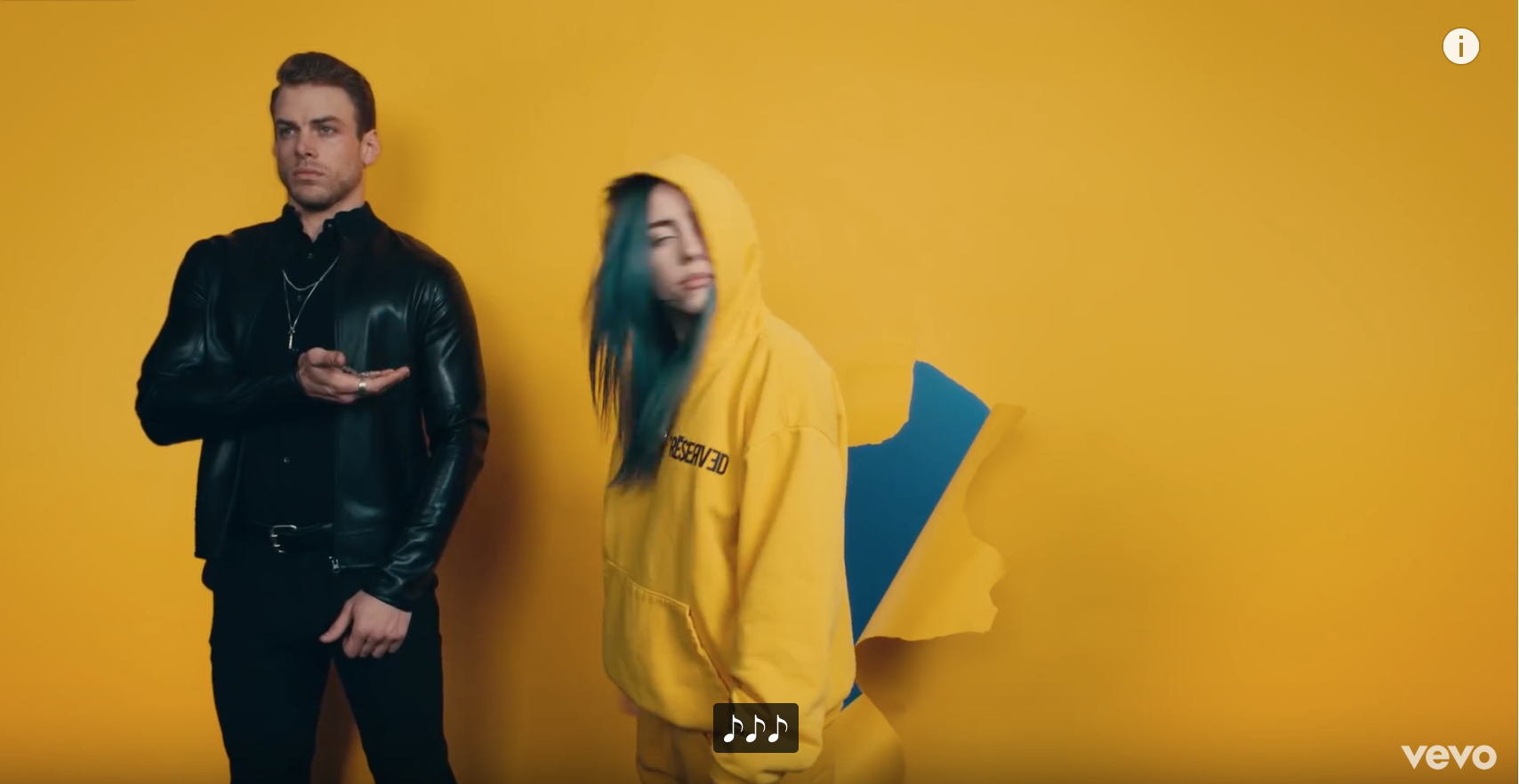
The opening scene is of Billie breaking through a yellow paper wall, dressed in a monochrome yellow outfit similar to the shade of the wall. The tear in the wall reveals a cool blue tone rip on the other side. Billie proceeds to give her Invisalign retainer to a bodyguard who sticks his hand out to receive it.

The camera cuts to the next clip of her standing in the center of the frame beginning to lip-dub the song. She is now in a monochromatic cool blue foreground dressed in a white shirt with blood dripping down her nose.
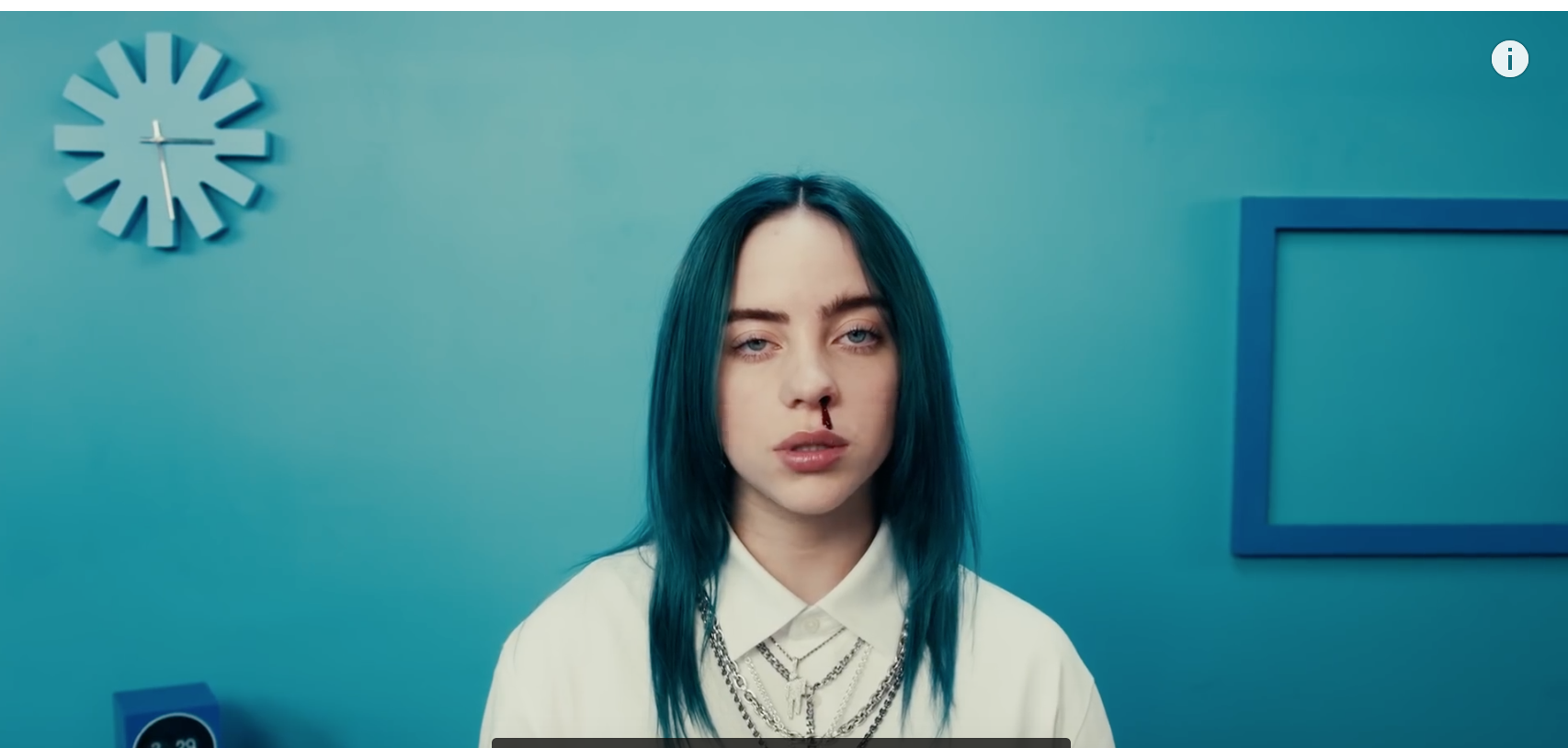
The camera then cuts back to the yellow room, where she begins to move her body to the beat. Her dance moves consist of her vibing to the song, slowly rocking her shoulders and tiptoeing to the beat. There is a quicker alternation between the two settings with shorter clips matching the pace of the song. In both settings, she continues to highlight the beat in her music. In the yellow room, she is now rocking her upper body aggressively to the beat and dancing to it.In the blue room, close up shots are taken of her knees flexing to the beat and of blood dripping to the beat.


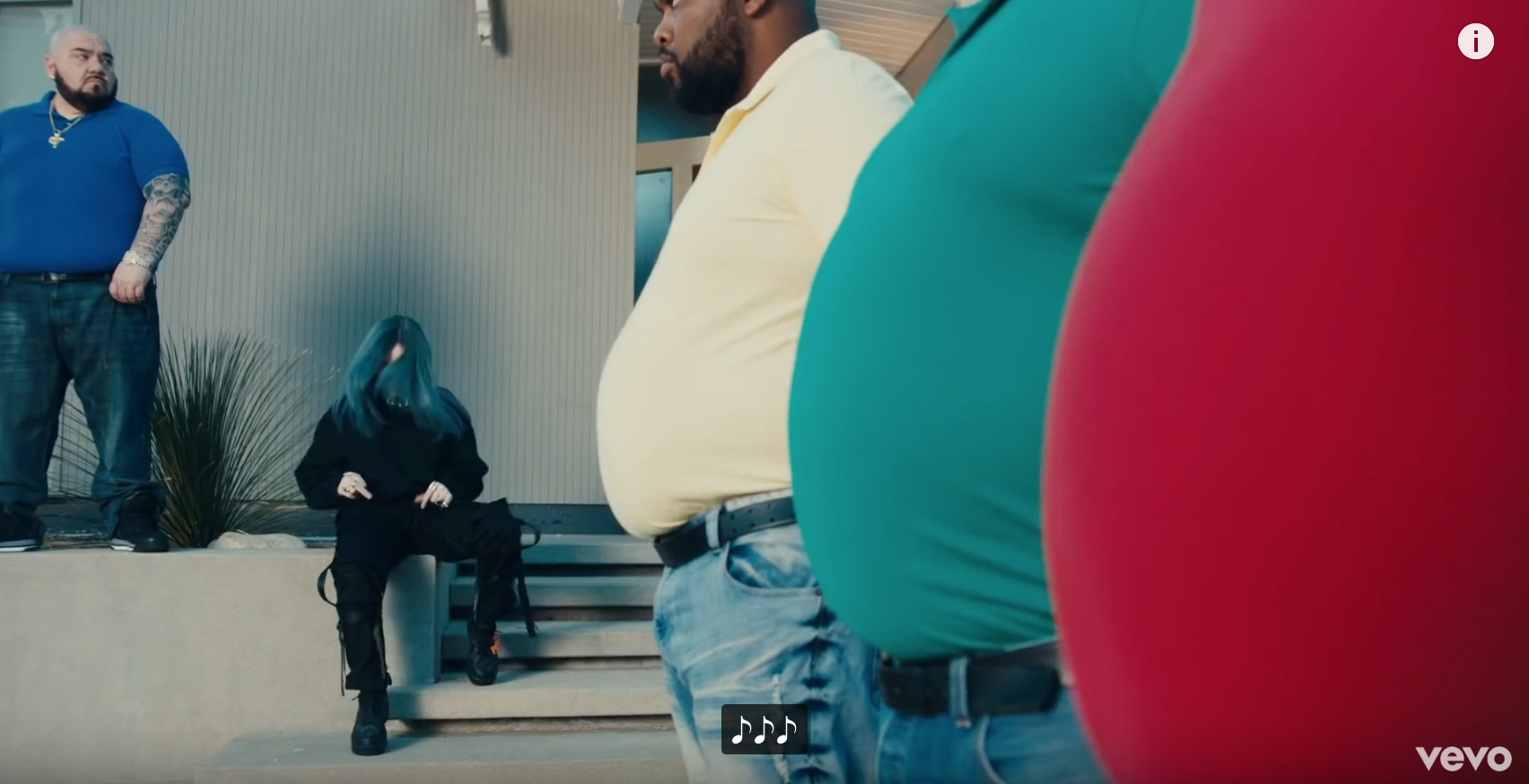
The next clip is a close-up shot that quickly pans out to the front porch of a house. Aligned to Billies left is a row of Men’s bellies, each dressed in different colors. Matching the lyrics of the song, the men all inhale and puff their chests to the beat

.

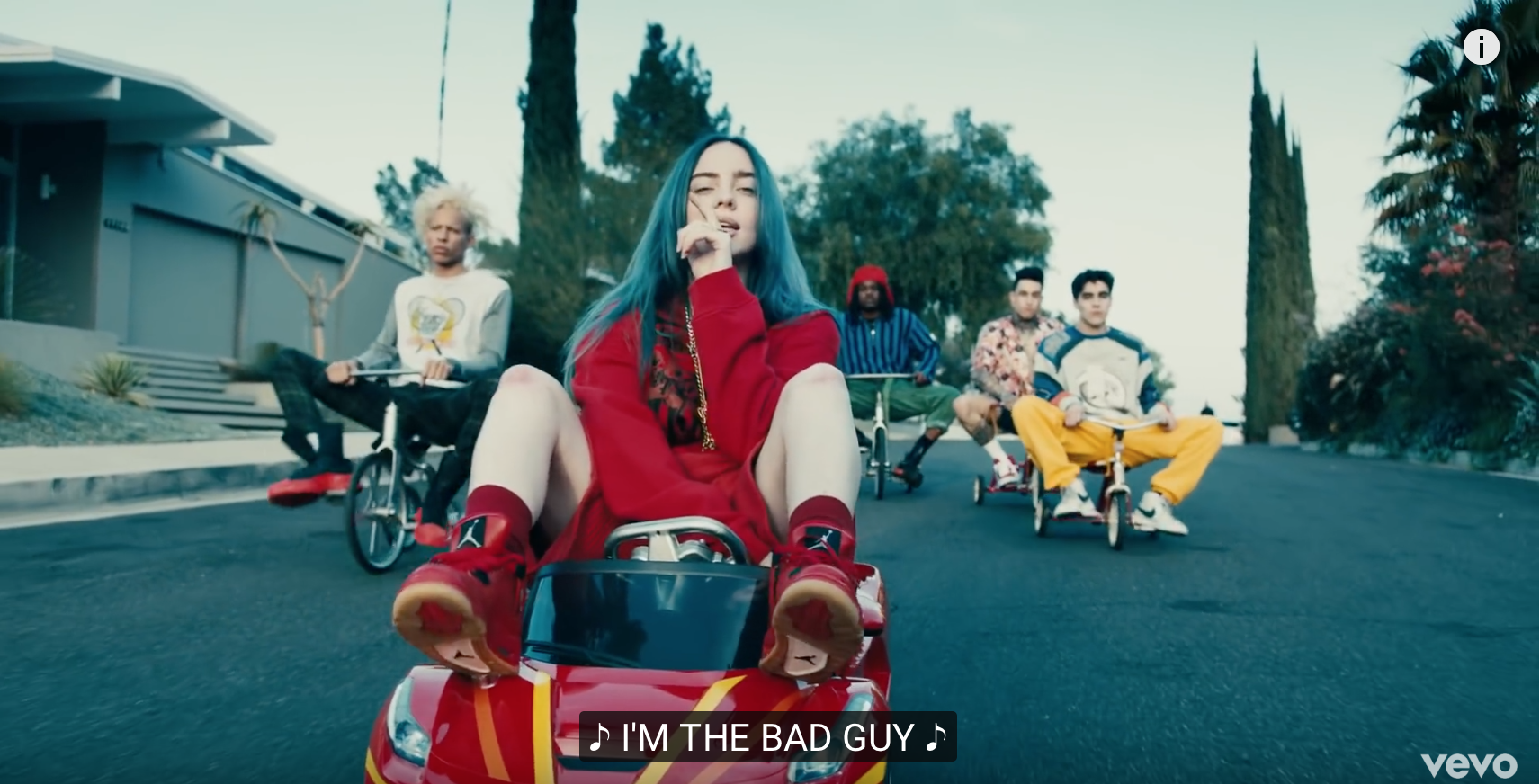
The next clip is of Billie riding a toy car down a street with an entourage following her. The clip cuts back to the blue room, where Billies bloody nose has now smudged all of her face. The clip cuts back to her on the car, still lip dubbing the song.

Alternating back between the blue room and the street scene, the next scene following that is an overhead shot of Billie Eilish in a very colorful outfit rolling around what looks like a rug that has a spiral print, nearly creating an optical illusion. The musical chorus alternates clips between Billie rolling on the carpet, the men’s stomach profusely inhaling and exhaling to the beat, Billie rocking back and forth in the toy car, and a scene where Billie is feeding pigeons.
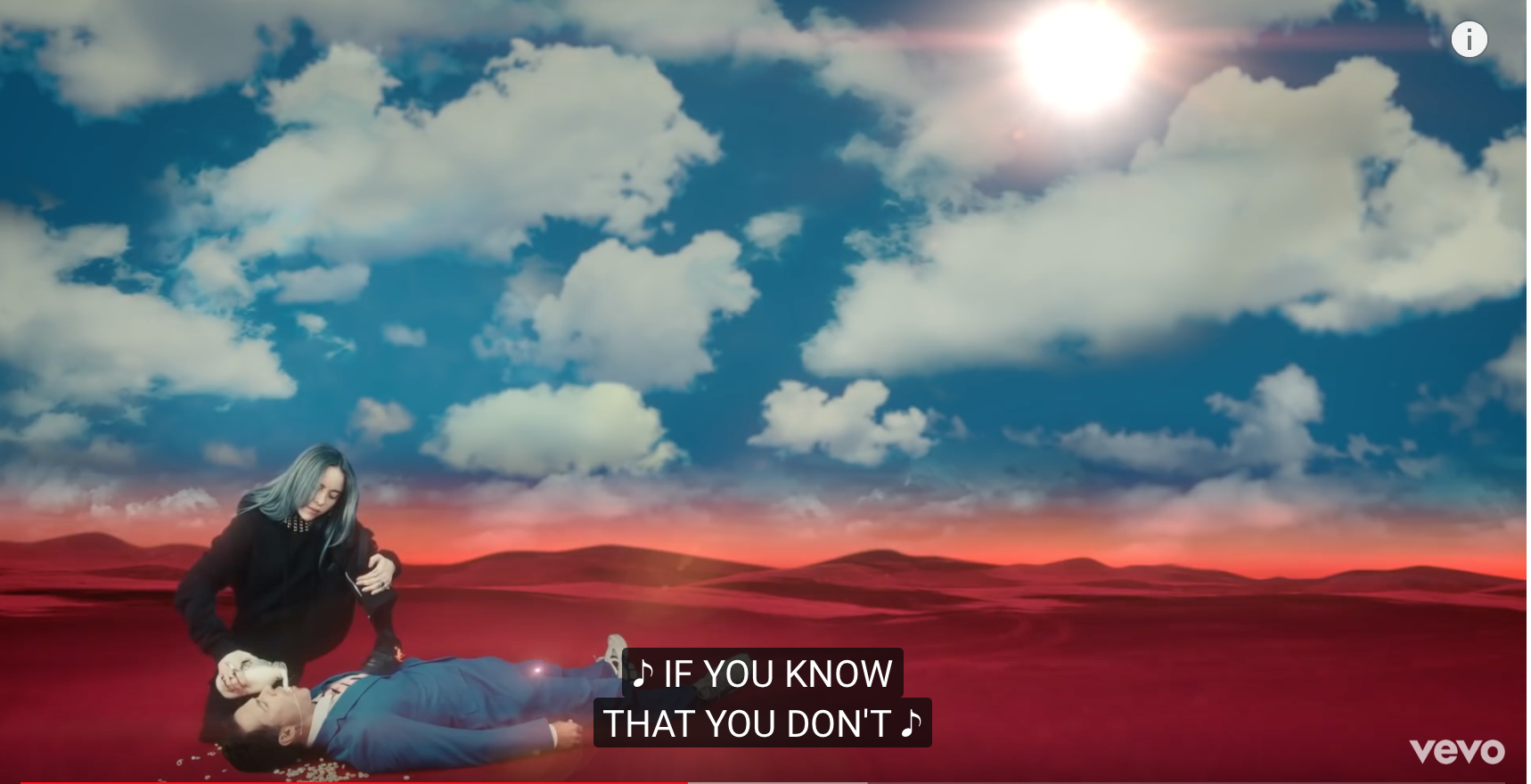
At this point, halfway through the video at 1.50, the scenes begin to convey a more spooky tone. Although the scene previous to the ones to come did contain blood, the following scenes portrayed Billie in a more aggressive role. For example; standing over a man that seems to be unconscious as she pours milk down his throat,
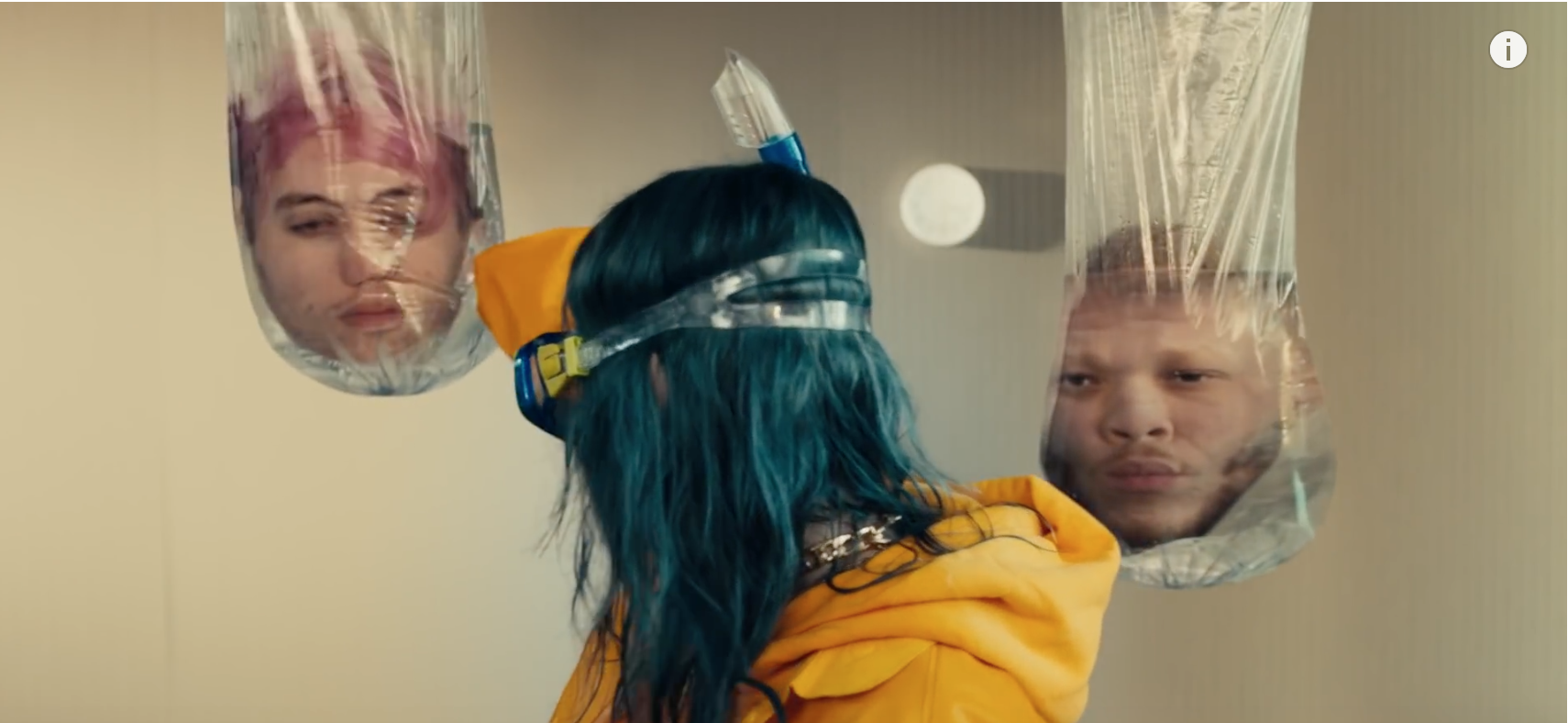
surrounding herself and poking holes into plastic bags filled with floating heads of different men,
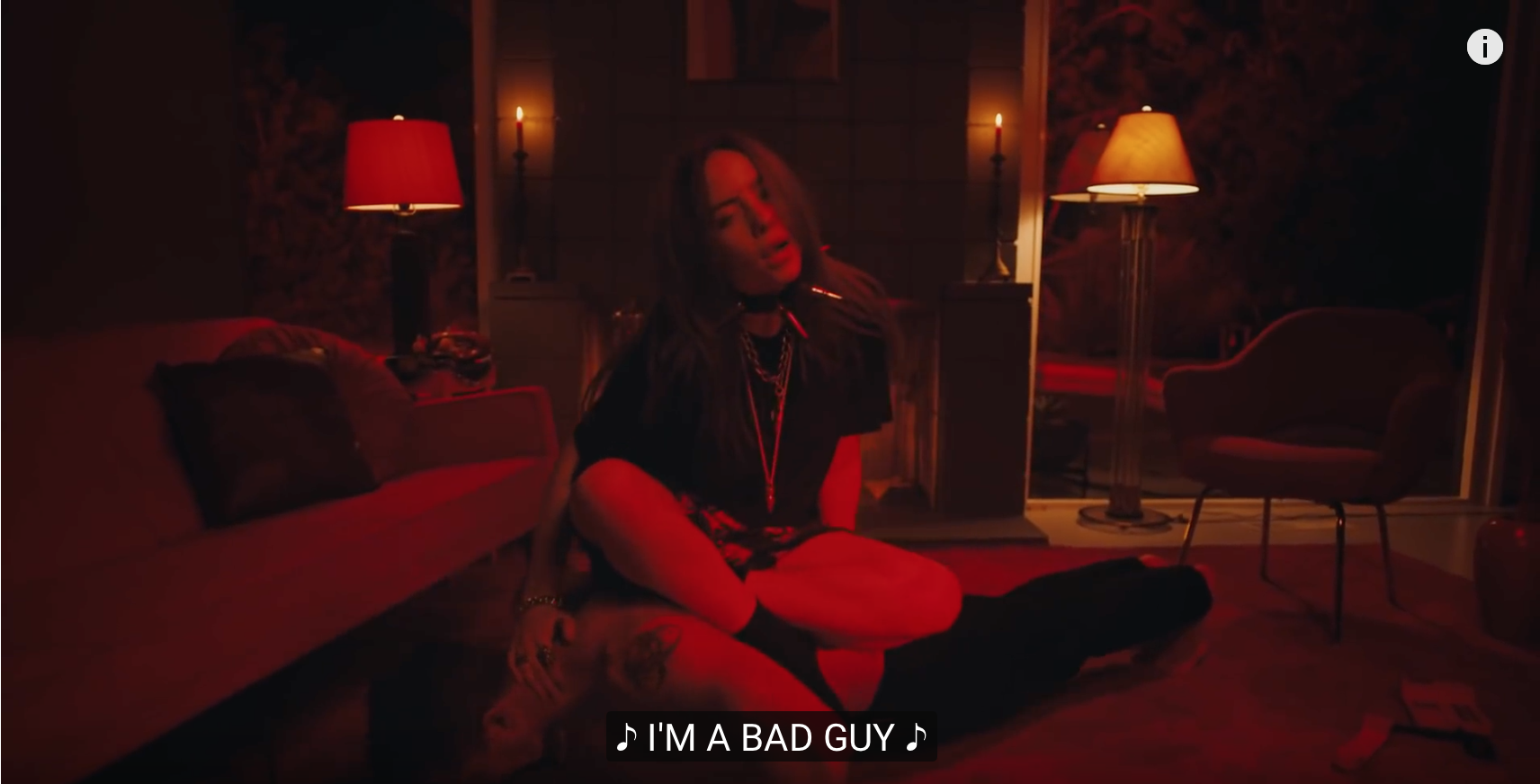
and sitting on the back of a man as he is doing pushups in a very dark room that is lit with red-light.
Similarly to the first half of the music video, the scenes are continually alternating while matching the pace and beat of the song.
You Should See Me In A Crown (2019)

This specific music video is different from the rest as it is based on animation and was produced by the contemporary artist Takashi Murakami. I have been obsessed with Murakami’s works for as long as I could remember and one thing that really differentiates him from other modern-day contemporary artists is his graphic identity. The animation-like characters that he develops into larger than life sculptures, paintings, and murals have turned Murakami into a household name in the contemporary art world. He has been inspiring artists in all fields, collaborating with fashion brands, musicians, and more.
What we see in this video is an animated/cartoon version of Billie Eilish, while still keeping her very cool-colored saturated visual aesthetic, the cartoons contain a lot of details that pay homage to Japanese Anime style cartoons and Takashi Murakami’s graphics.
I think the fascinating aspect of this music video is the way that Murakami was able to capture Billie’s movement through the animated drawings. Unlike any normal choreographed music video, this almost felt like one of her signature music videos, containing her signature dance moves and movements that evoke her unique personality. It was almost weird to see how human-like some of the animated characters movements were.

When The Party’s Over (2018)

When The Party’s Over has to be one of Billie Eilish’s most iconic music video, in my opinion, as it explicitly shows her growth leading to this video. This video reminded me so much of her first music video “Ocean Eyes”(2016), Where a young Billie Eilish, aged 14, lip dubbed her entire song while marking her cheeks with dark ink streaks from her stained fingers. To say this song’s MV is simply a more evolved version of Ocean Eyes (2016) is an understatement and I see it more as a sequel.
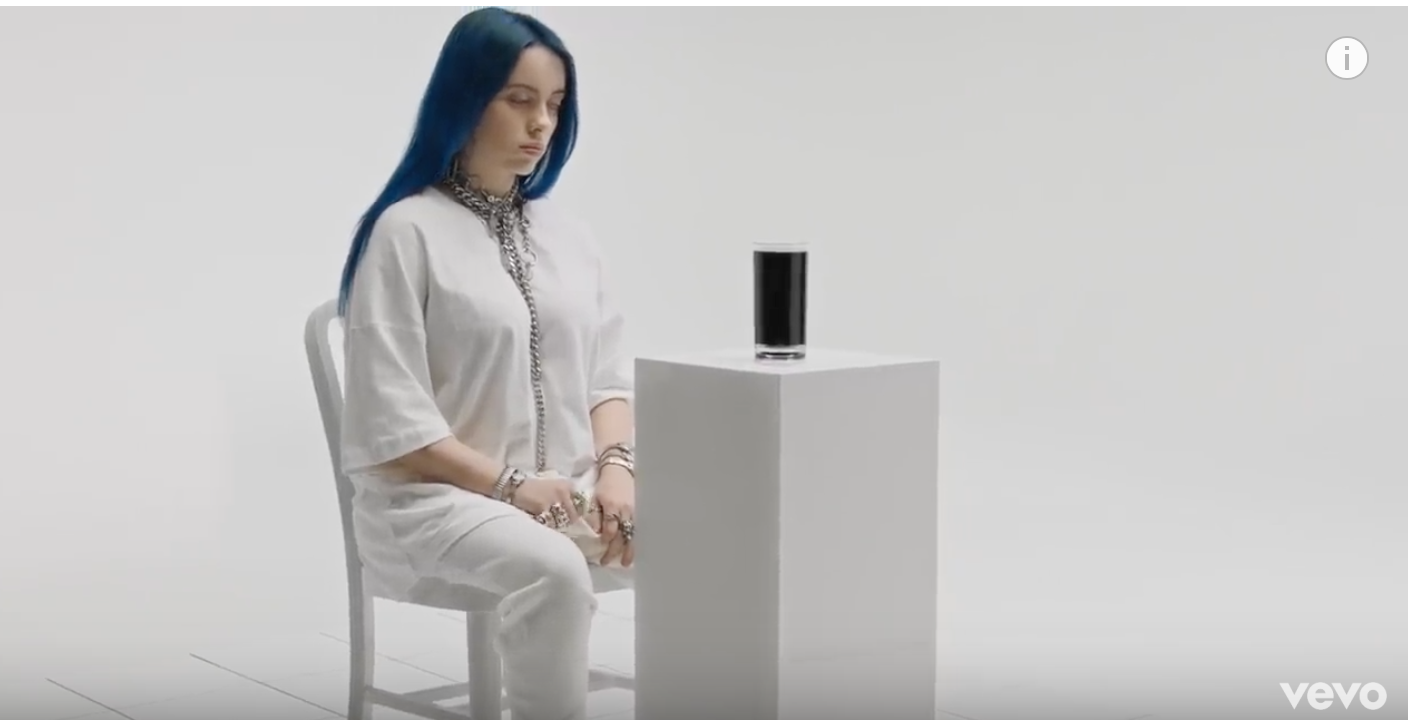
The music video begins with a very close up shot of a glass filled with black liquid. As the camera starts to pan out, we see the stark contrast of what is in the cup to the all-white surrounding. Billie is seated in front of the cup dressed in all white. The vibrancy of her dark blue colored hair, as well as her silver chains and jewelry, stand out against the monochromatic setting.


The camera angle is precise at 0.40 as it is below eye-level and leaning towards the left corner of the frame, placing Billie in a sort of profile -like position. We can see her seated in front of the glass filled with the dark substance, itching to drink it.


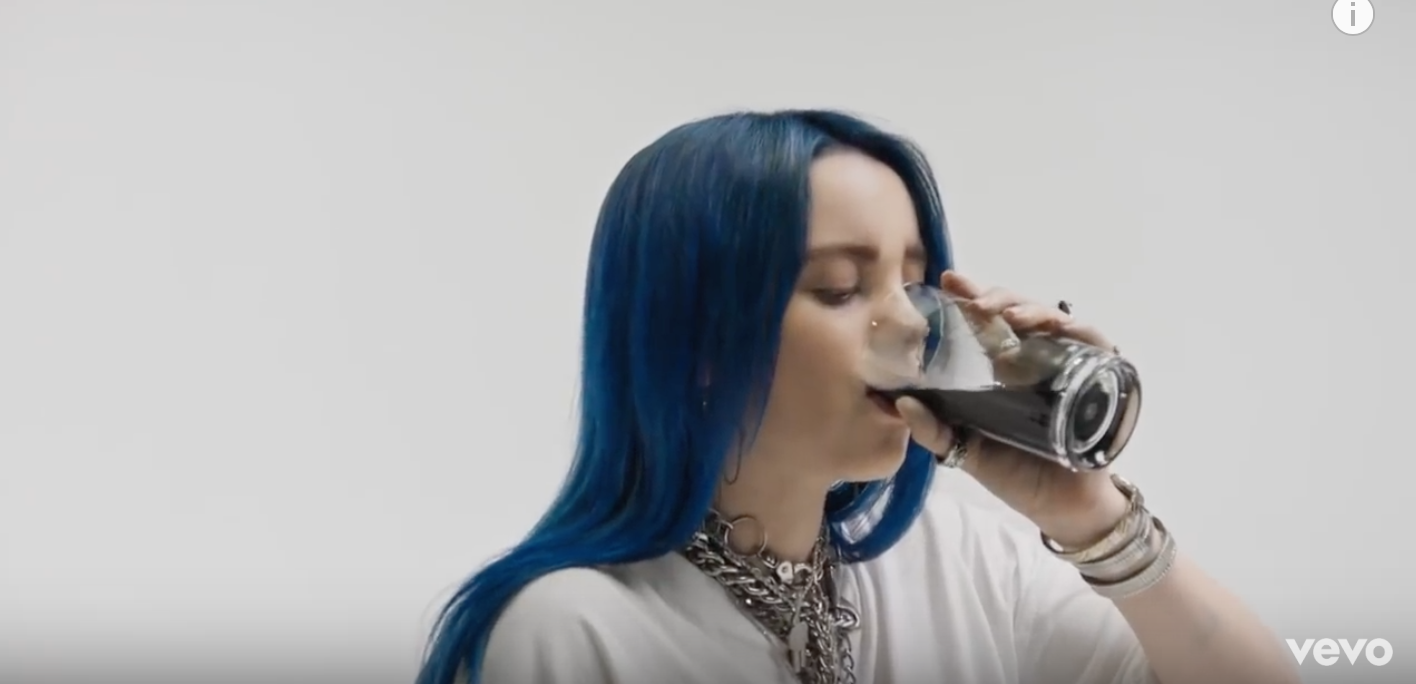
At 1.00 she finally grabs the cup to drink it and hesitantly drinks the entire glass, while the camera zooms into her face as she struggles to swallow the liquid. After exaggerated gulping, Billie begins to aggressively and over exaggeratively begins to flinch. At 1.49 she regains control of herself and stares straight into the camera lens.

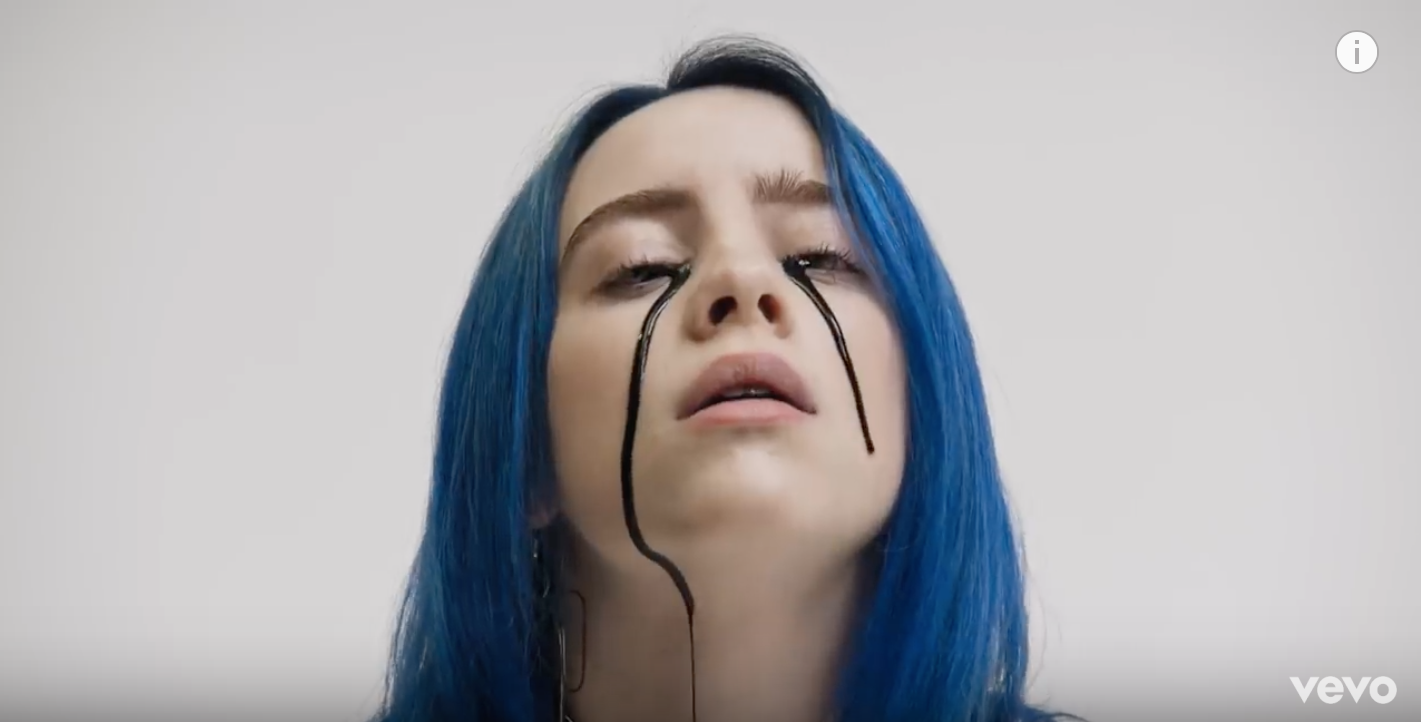
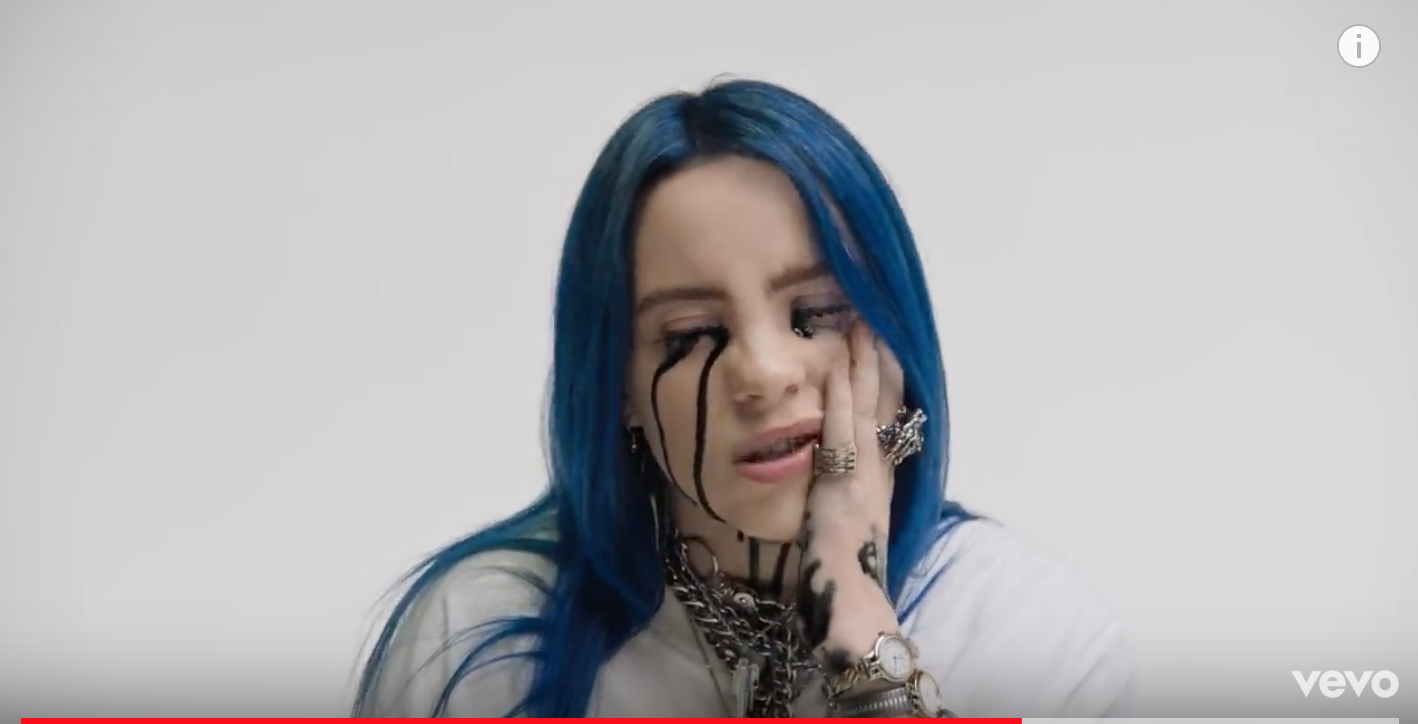
She lifts her head and allows for a dark-colored tear to roll down the side of her left cheek as another dark tear rolls out of her right eye. At 2.00 she begins to lip-dub and singalong to her chorus as dark black streaks run profusely down her face. She continues to flinch and blinks her eyes aggressively as the tears pour down along her neck. Her eyes begin to darken as the pigmentation starts to take over her eyeballs. The corners of her mouth begin to leak the same liquid, and at 2.22, she begins to smudge the dark liquid all over her face. In the same motion as she did in Ocean Eyes. This time the dark substance had been ingested through her drinking it. It was coming from within her rather than it just being present superficially and on the surface-level.

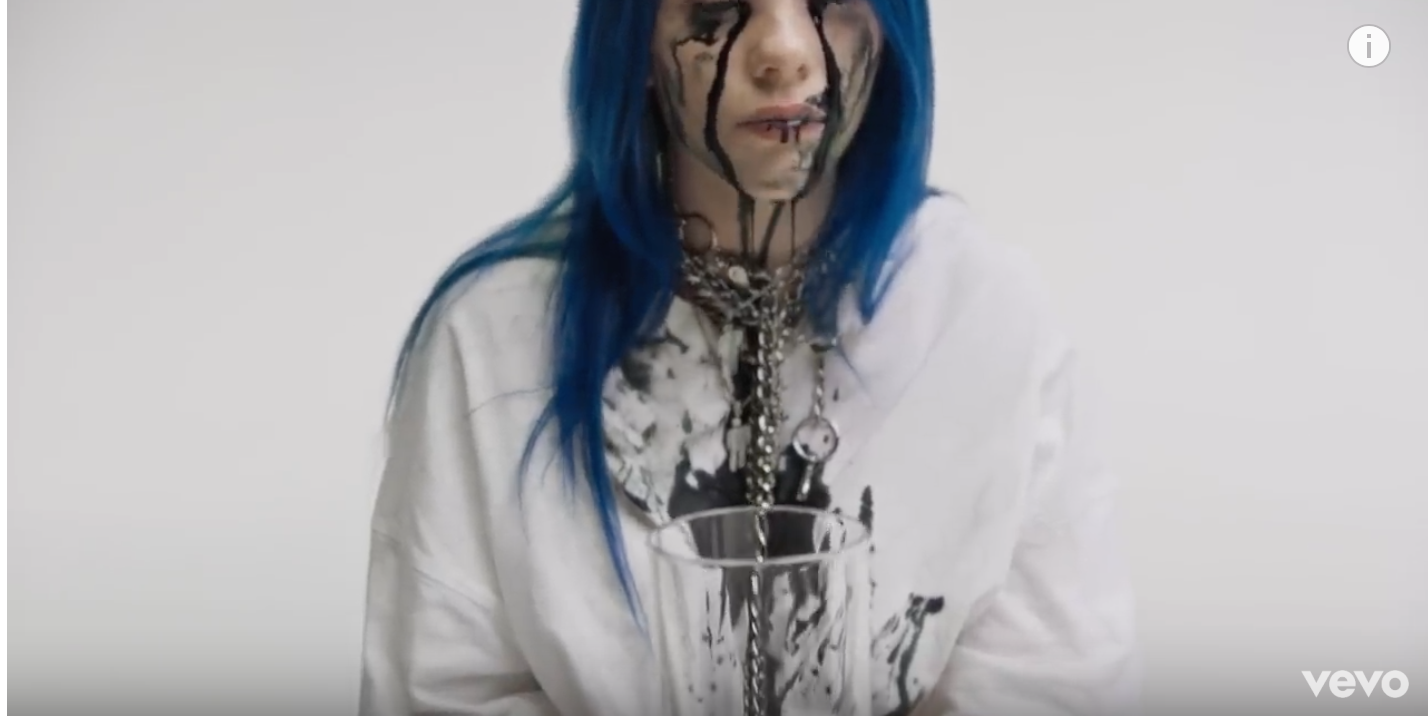
The camera begins to pan downwards, slightly below Billie’s head revealing how the dark substance splattered across her chest, staining her white clothing.

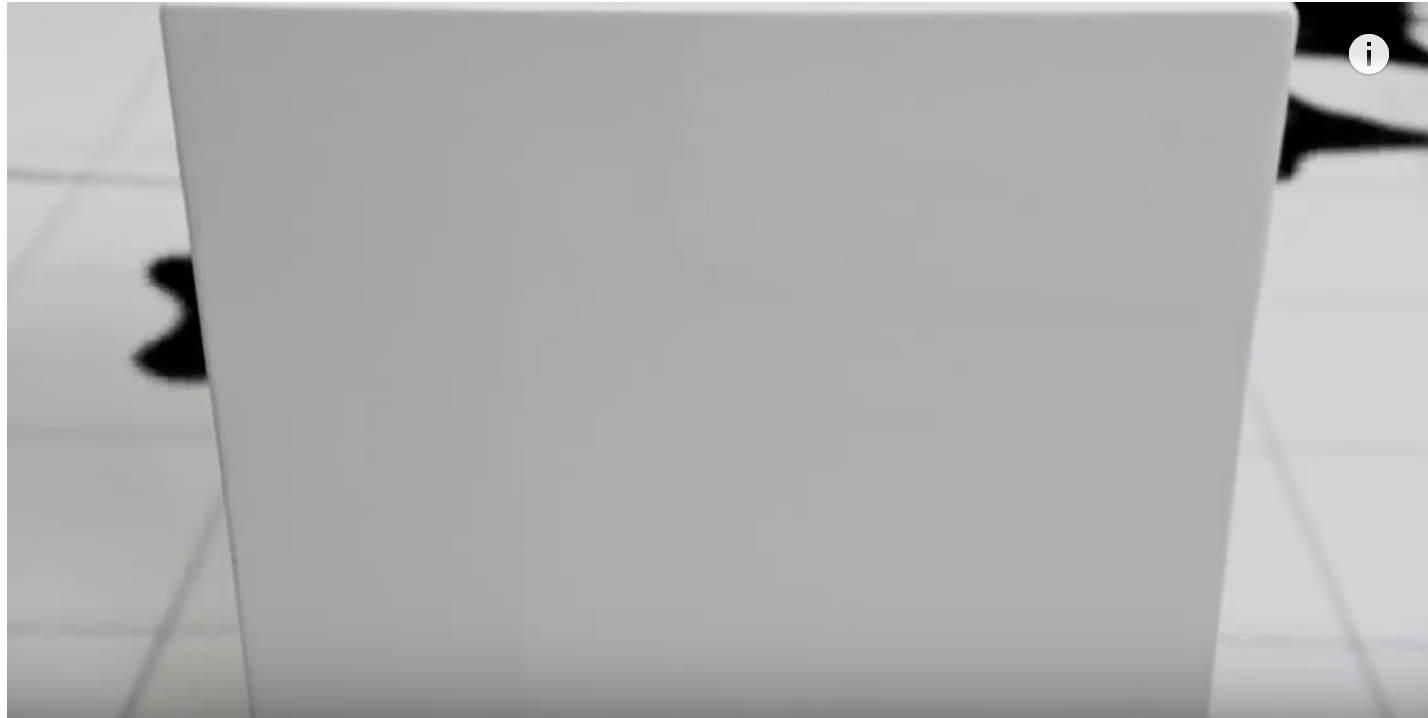
The camera continues to pan downwards, towards the empty cup and the white platform that it is on. The closing shot depicts the bottom of the white platform in focus while the dark liquid continues spilling onto the ground in the foreground.

Lovely (2018)

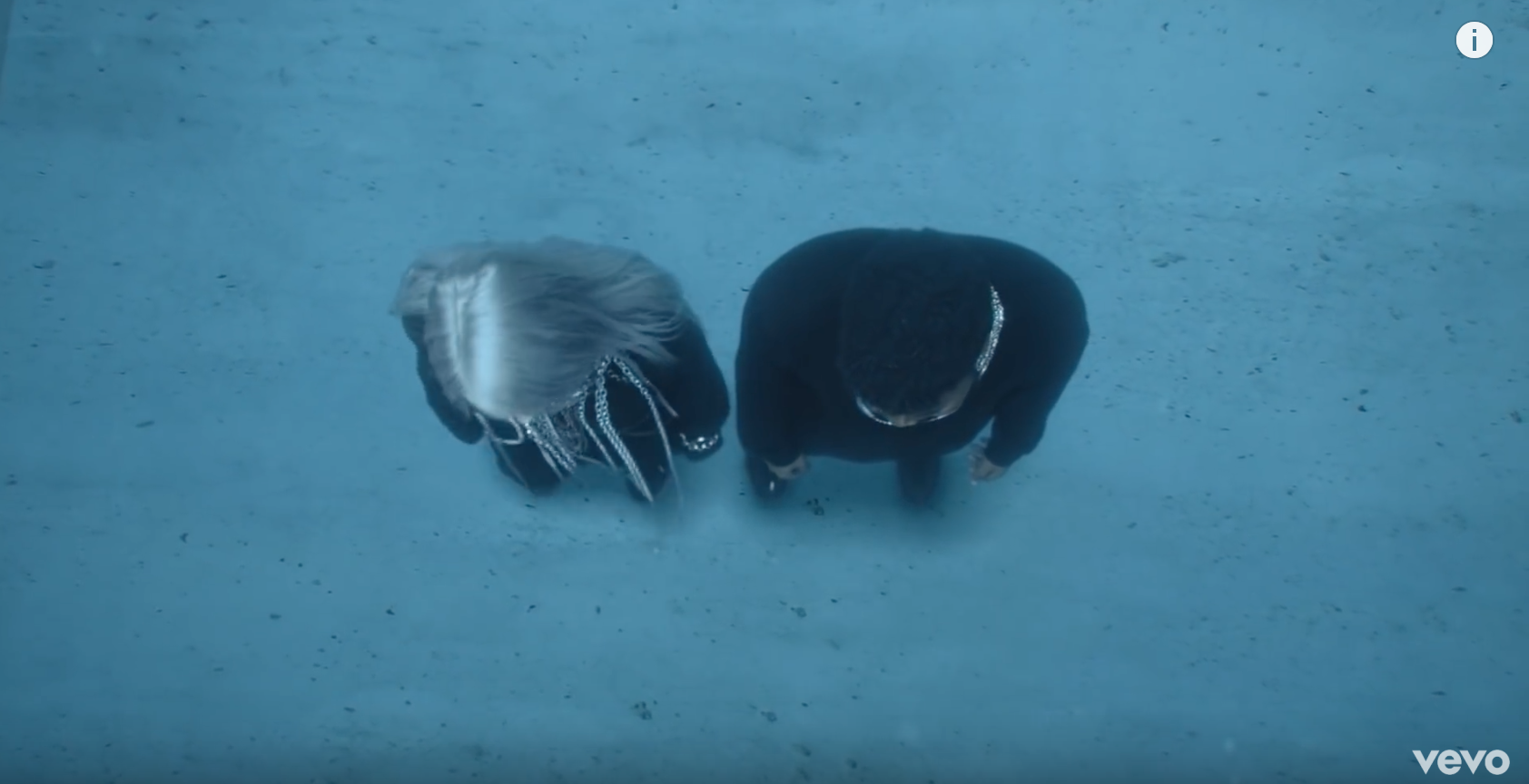
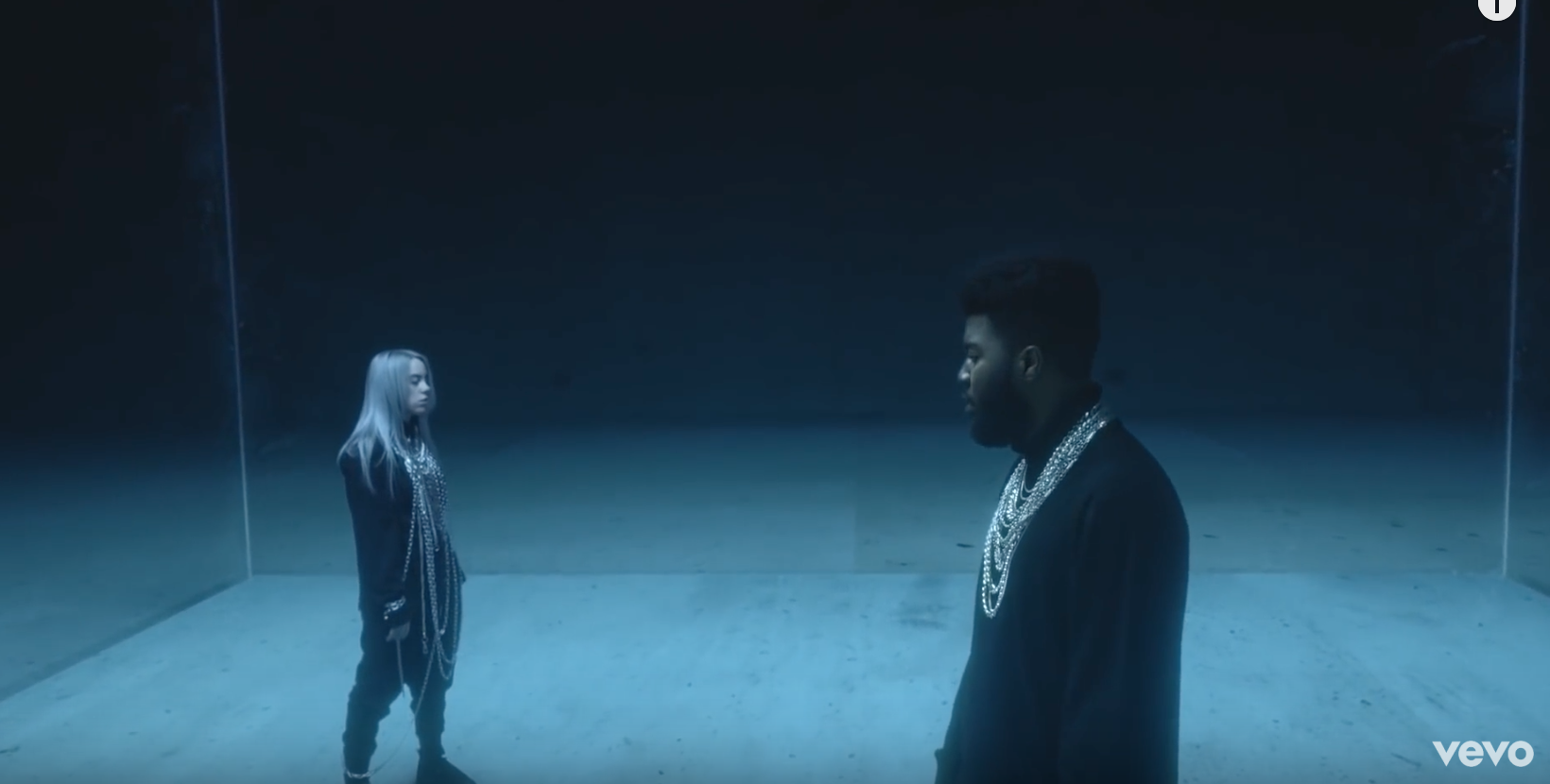
In this music video and collaboration with Khalid, The opening shot is of Billie Eilish crouched down on one knee in a giant glass box. The box has ample space to move around, but Billie is adorned with chains that act metaphorically and physically as a limitation to her movement. She has on black headphones that go along with her all-black outfit. The camera pans in and across the box, in somewhat of a circular motion smoothing out the harsh 90-degree angles. The camera then zooms into Billie Eilish’s face, and she begins to lip-dub her singing. Since it is a duet and collaboration with Khalid, once we hear Khalid harmonizing, he appears in the foreground, while the camera focuses on Billie. Billie then walks out of the frame and Khalid walks into the frame. They begin to circle each other as the camera follows them both at eye-level. Billie and Khalid are somewhat interconnected, not only through there voices and lyrically, but through there movement. The choreographed duet allows for the movement between them to highlight the lyrical aspect of the song. Both dressed in black from head to toe; they are visually and musically in unison.

The style of this music video gives the viewer the impression of one long take. Rather than staying in one place, the camera travels along with the space and creates an extensive range of angled shots within the boundaries of the glass box and its surrounding.


Aesthetically, Billie Eilish’s signature cool tones are very much present. Natural elements such as a cloud are introduced. The fluffy cloud is juxtaposed with the harshness of the sharp glass box. The glass box goes through natural phenomena when it begins to rain inside of it, and it eventually freezes, as though it has somewhat gone through weather changes.

idontwannabeyouanymore (2018) vertical video

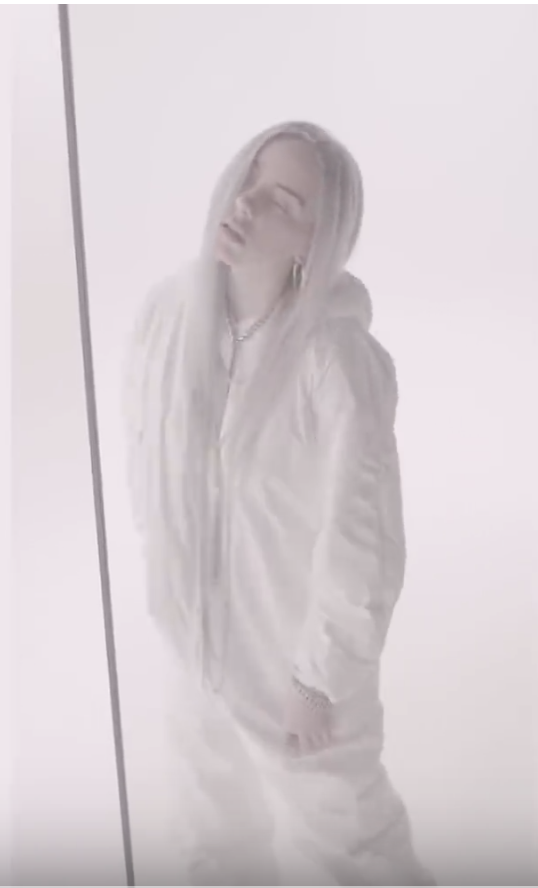
            This music video is specifically special because it is a “vertical video”. A vertical video takes into account the device in which the video is being played. Being published on the platform “Youtube”, most viewers have access to it on a smartphone and share it usually through other forms of social media on their smartphone. It is very interesting to see how she caters to the viewer but also how a very important element/ prop in the video is a vertical full-legth mirror that Billie faces for the entirety of the video. This could have been the motivating factor to use the “vertical -effect”.

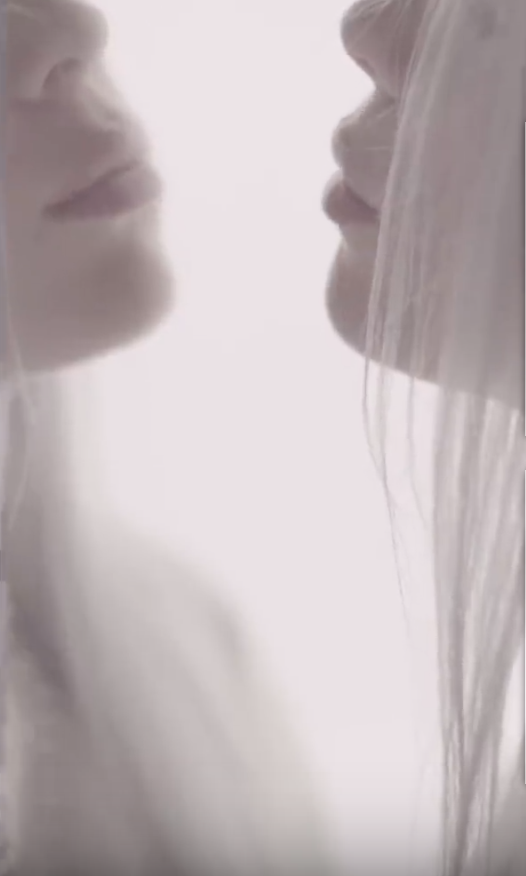
            The opening shot is Billie EIlish in a monochromatic white outfit. She blends into the very light pink background and is standing facing a full-body vertical mirror. After establishing the scene, the camera begins to slowly zoom into Billie. Once Billie and her reflection take up the entirety of the vertical screen. The camera begins to zoom into Billie’s mirror reflection. Once the edges of the mirror disappear as the camera is continuously zooming into Billie’s reflection, we lose the sense that this is Billie’s reflection and are left with Billie facing the right side of the screen. This loses our senses in recognizing where the viewer is in the video. 


 This video’s clips alternate as the beat of the music speeds up and slows down. This is also the case with Billie’s movements. The storyline is very simple as she is singing the song to herself through the mirror for the entirety of the MV, but the way the video was edited creates a more complex storyline, almost hinting at a fight or internal conflict within Billie’s mind. The alternating of camera angles also highlights this conversation between herself and her reflection and allows the viewer into a very intimate moment between herself, her thoughts, and her physical reflection.

Watch (2017)

            This video is specifically interesting as it is Billie Eilish’s most choreographed or dance-based video. Rather than just featuring herself lip dubbing her lyrics, an entire dance crew surrounds her for the majority of this mv. This dance aspect really highlights the play on movement choreographed and edited on the beat.

The recurring presence of symmetry and the ladder(“Bored”(2017) and lighting things up(“Six Feet Under”(2016) can be seen in the past videos that she made before this one, so it is very cool to see the continuity of these elements.

Bored (2017)

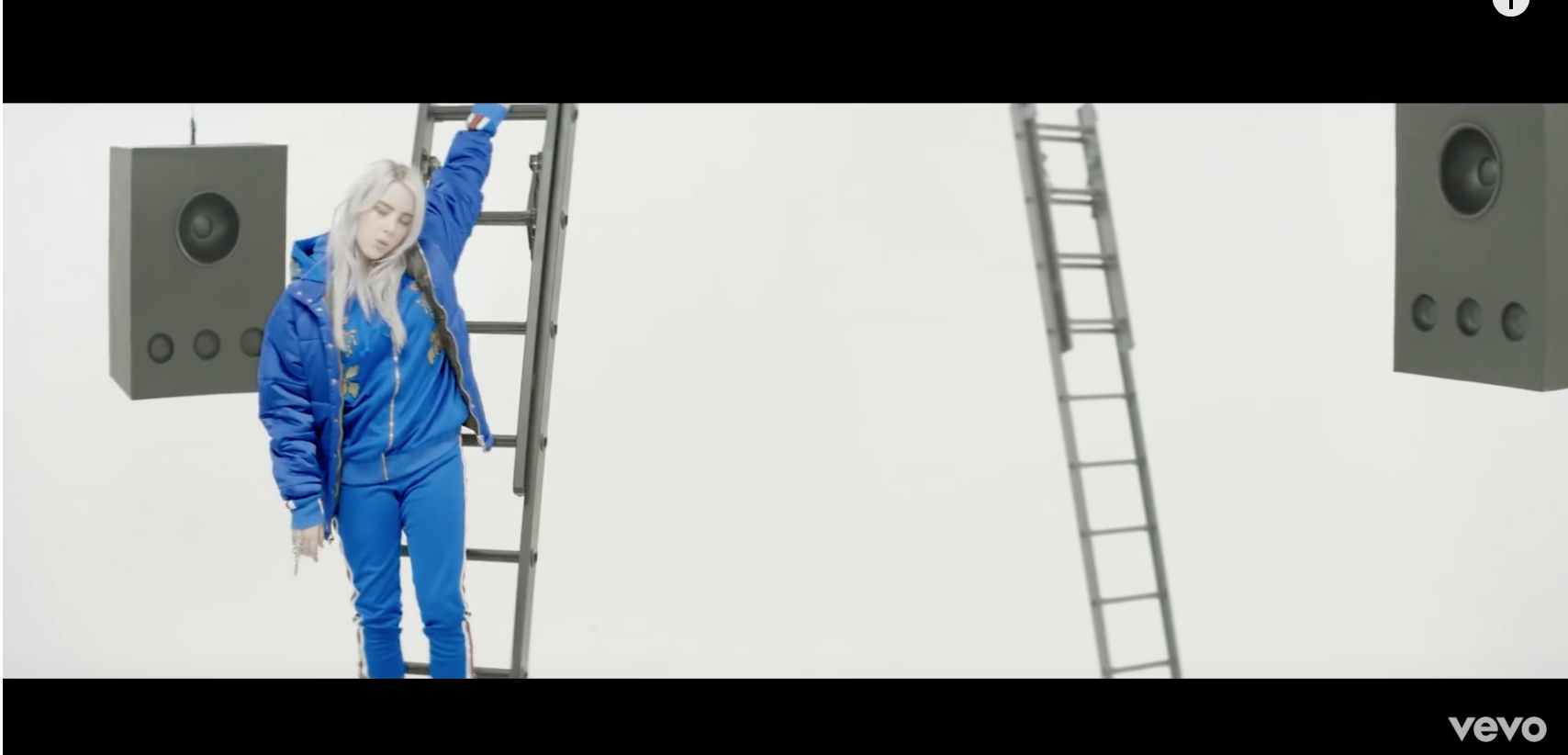
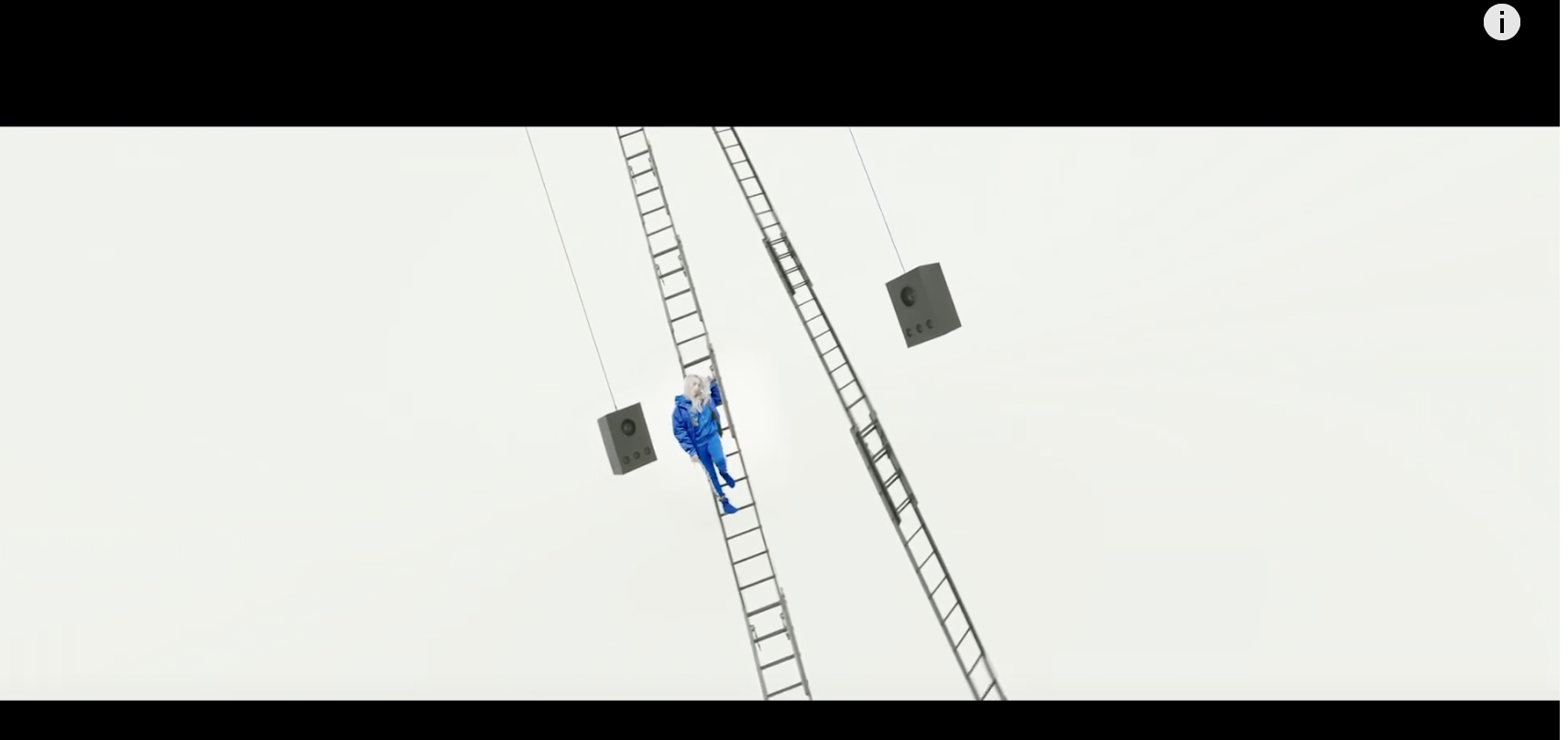
The opening shot of this music video begins with a blank white screen. The camera slowly begins to pan out to reveal that the initial white shot was the space between the ladder which is the focal prop and the main visual aspect of this video. The interesting part is the way the camera is cutting off this immense ladder and the awkwardness of some shots. The way the camera cuts it off puts the viewer in a place where they lose direction or there “placement” in this overwhelming space. 

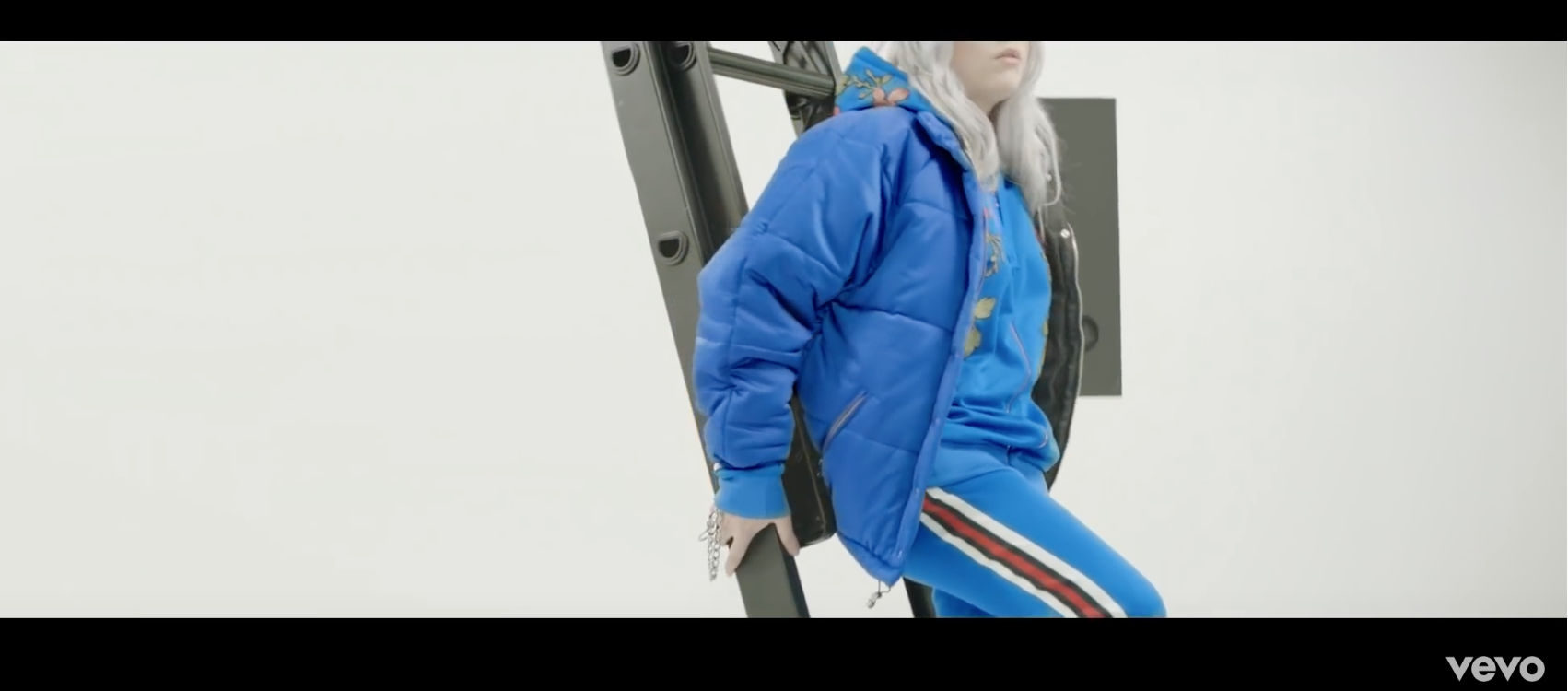
            Billie is seen climbing into the frame as the camera pans out, and this allows the audience to have a reference in terms of the size of this ladder. Billie’s monochrome electric blue outfit contrasts very strongly against the plain white background ang steel outlined ladder. Once Billie has climbed her way into the frame, the camera begins to zoom back in. There is a play with symmetry as the placement of two large speakers opposing each other, one on each side of the ladder is highlighted by the framing of the clip.

            In a kind of balancing act Billie places herself to one side as she makes her way around the prop, sitting on the ledge, leaning onto the steps, standing while dangling half her body off of the ledge. The camera work involved much shorter clips and much more complex camera placements, as close-ups, under shots, and focus shifting shots were all used as the pace and beat of the music sped up. Unconventionally, the frames were crooked, and it was very interesting to see how the camera work was able powerful symmetry of the ladder and focus on Billie.

The set and backdrop are so powerful, clean, and minimalistic. For some reason, I felt uneasy watching this music video as there were scenes wher Billie is seen hanging on the edge, kneeeling of the ladder, and really creating shapes with her body that would be risky on any ladder, or in this case, what appears to be an insanely large ladder thousands of feet off the ground. She never really fully falls off the ladder which conveys a very suspenseful tone as the viewer waits to see what will happen.

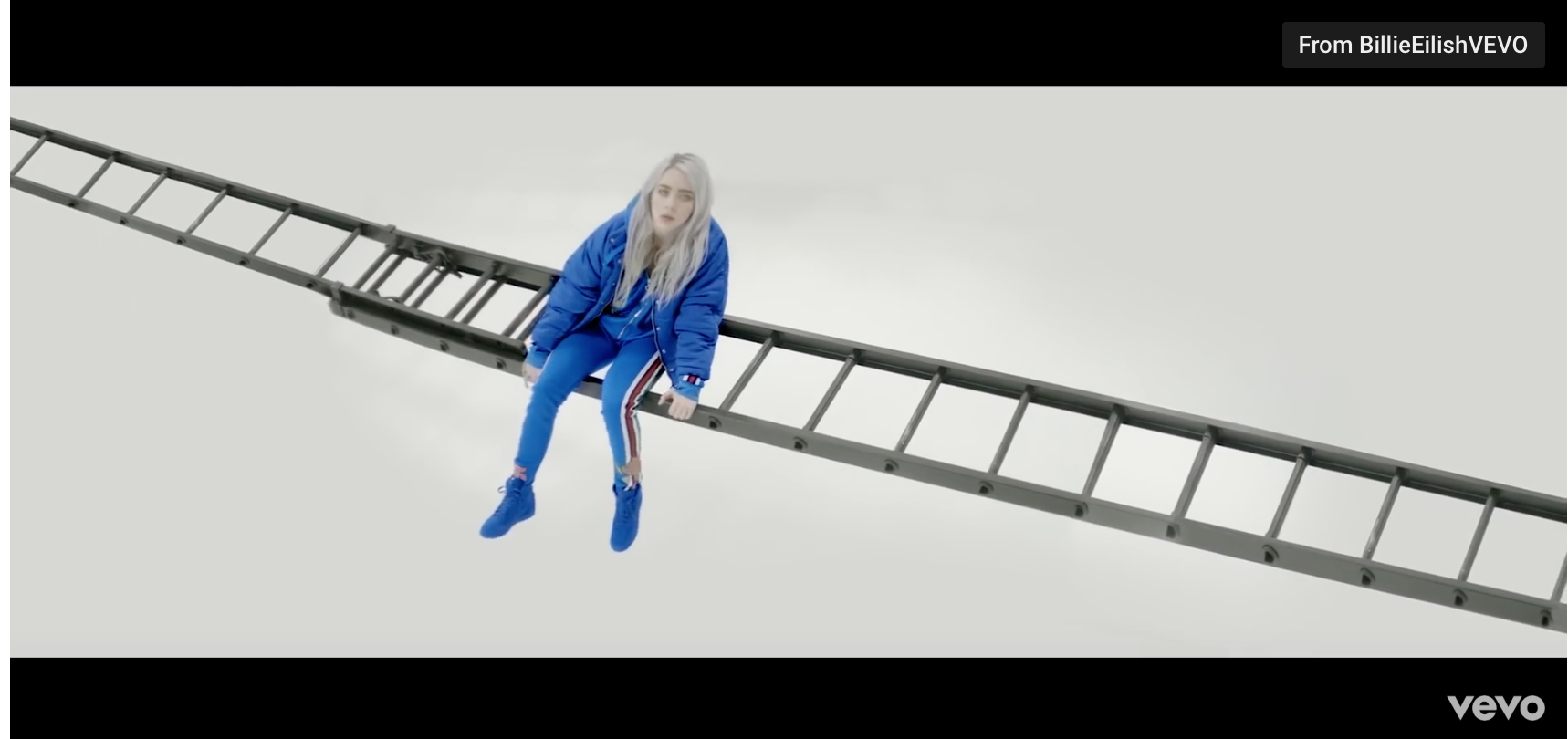
The ending shot, after the sort of compilation of zoomed in shots, is a pan out shot that is tilted and where most of the ladder is shown. The sizing and scale of the ladder juxtaposed with Billies contrasting smaller size is highlighted.

Bellyache(2017)

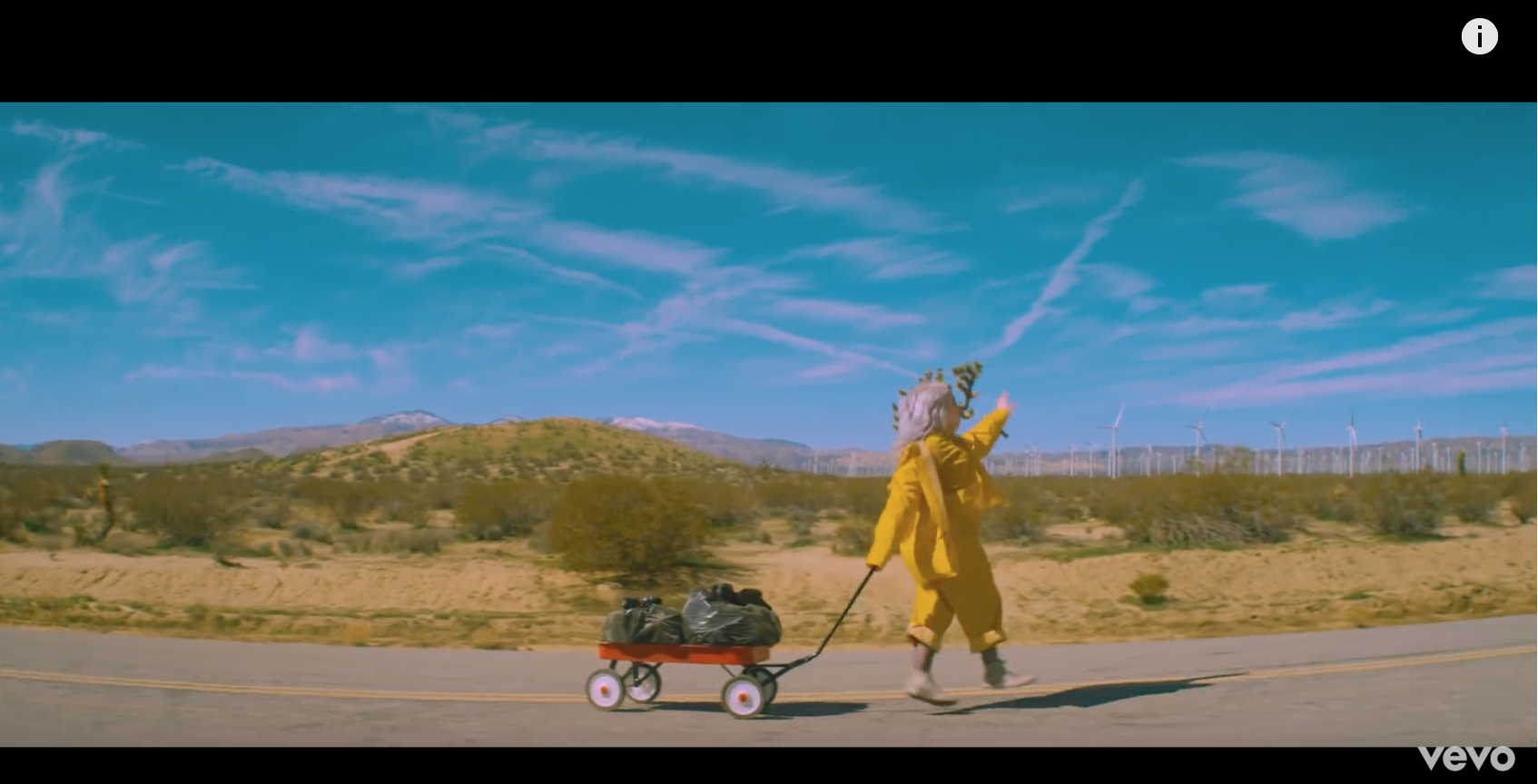
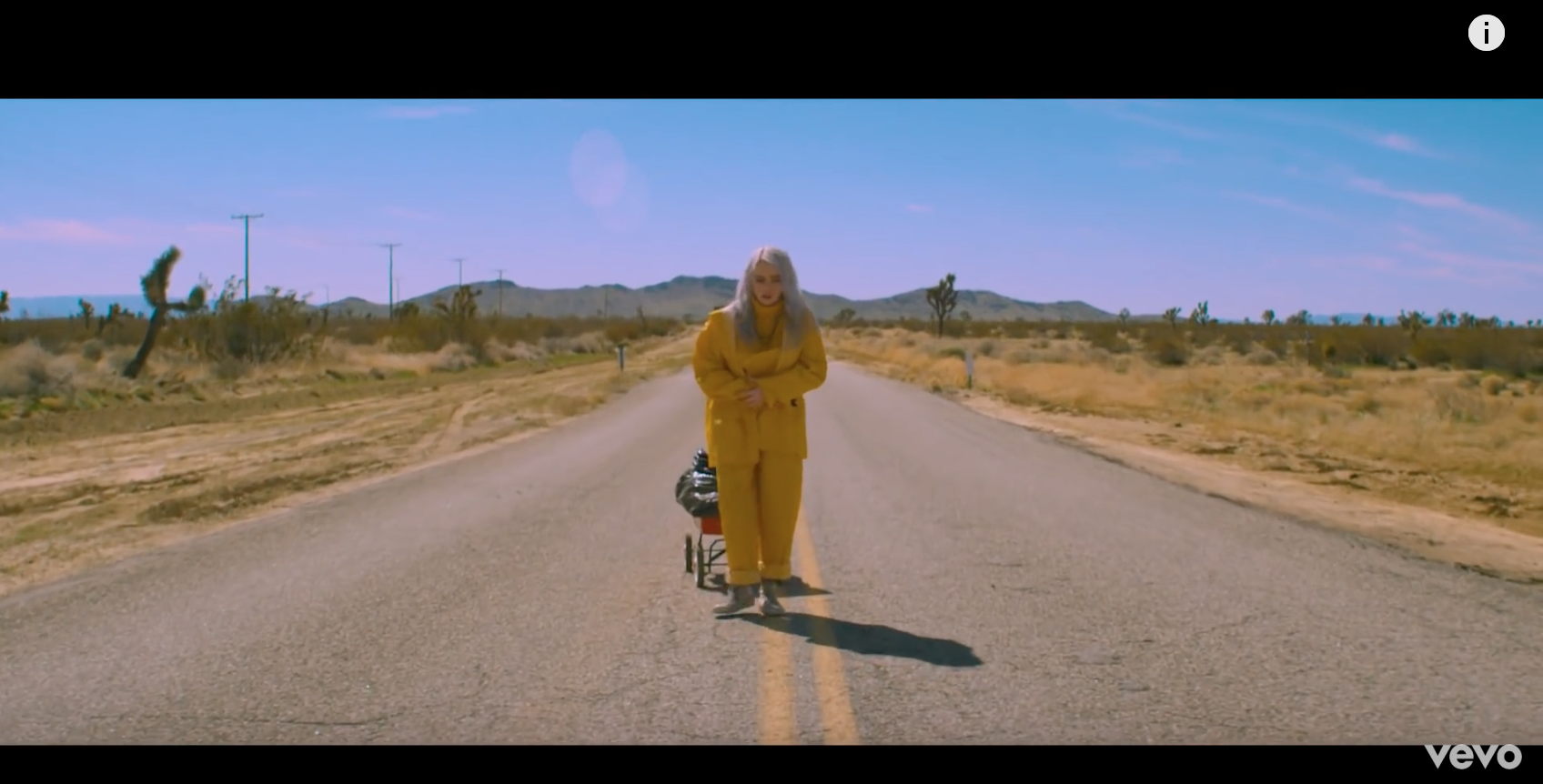
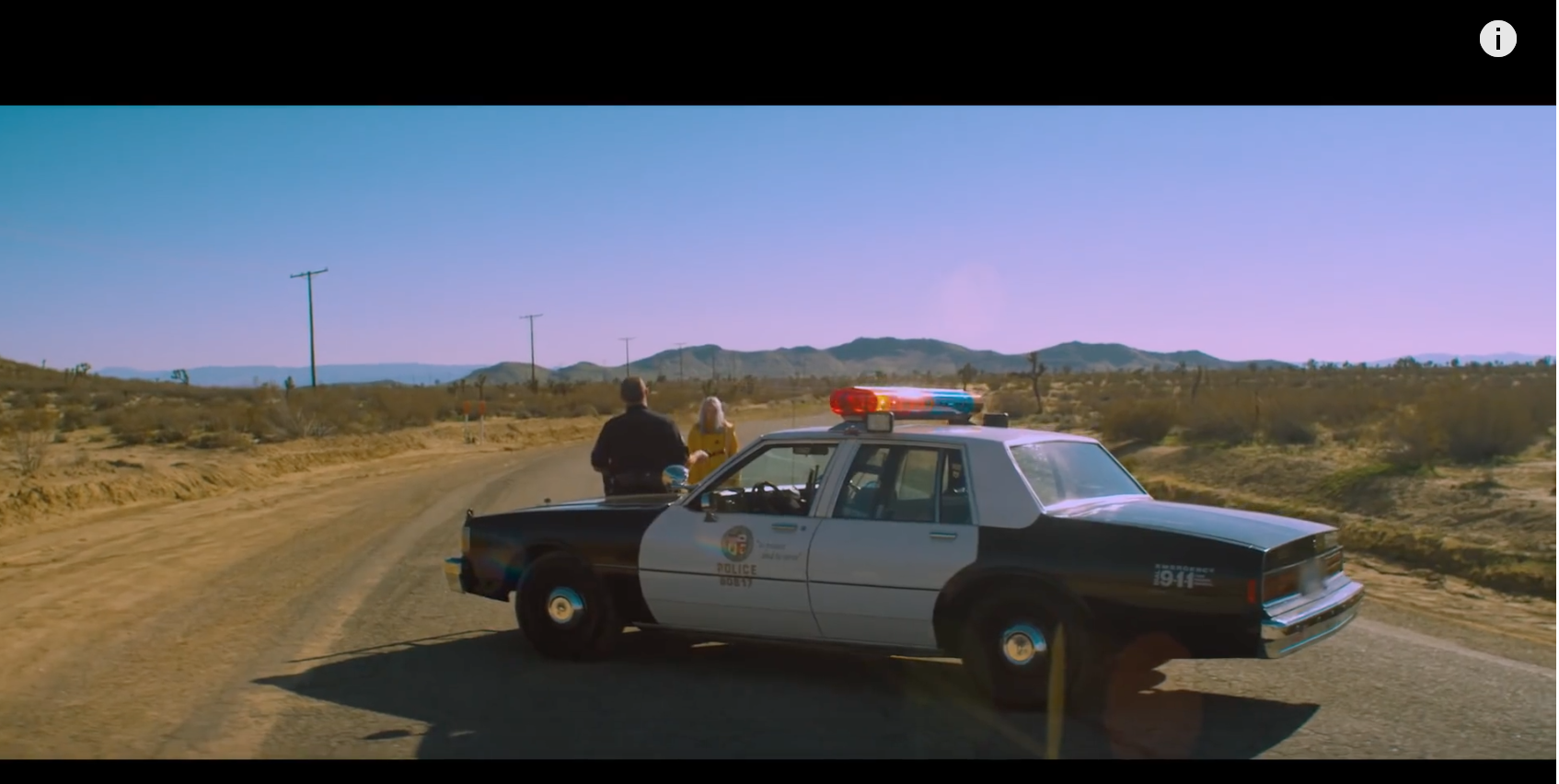
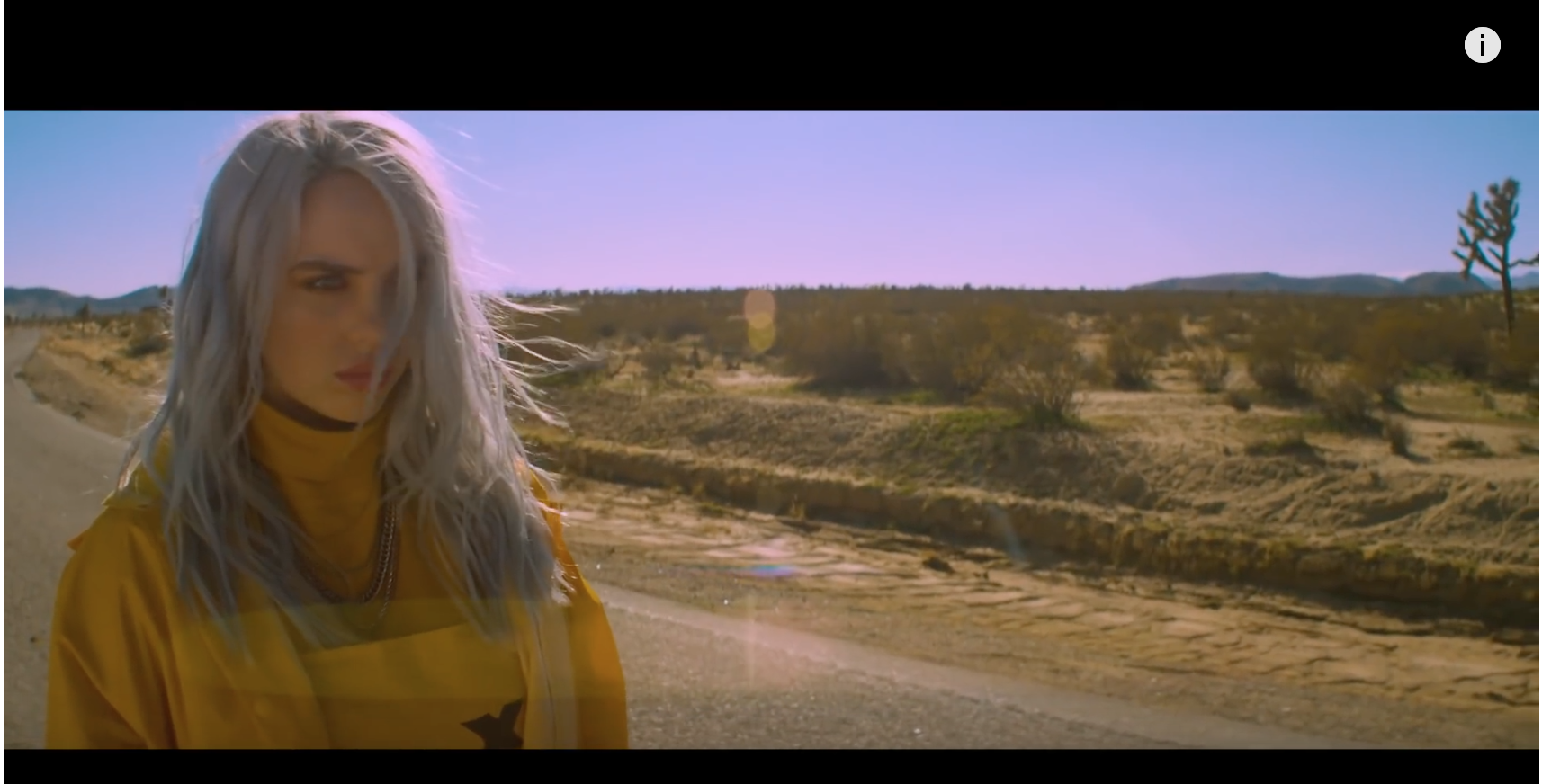
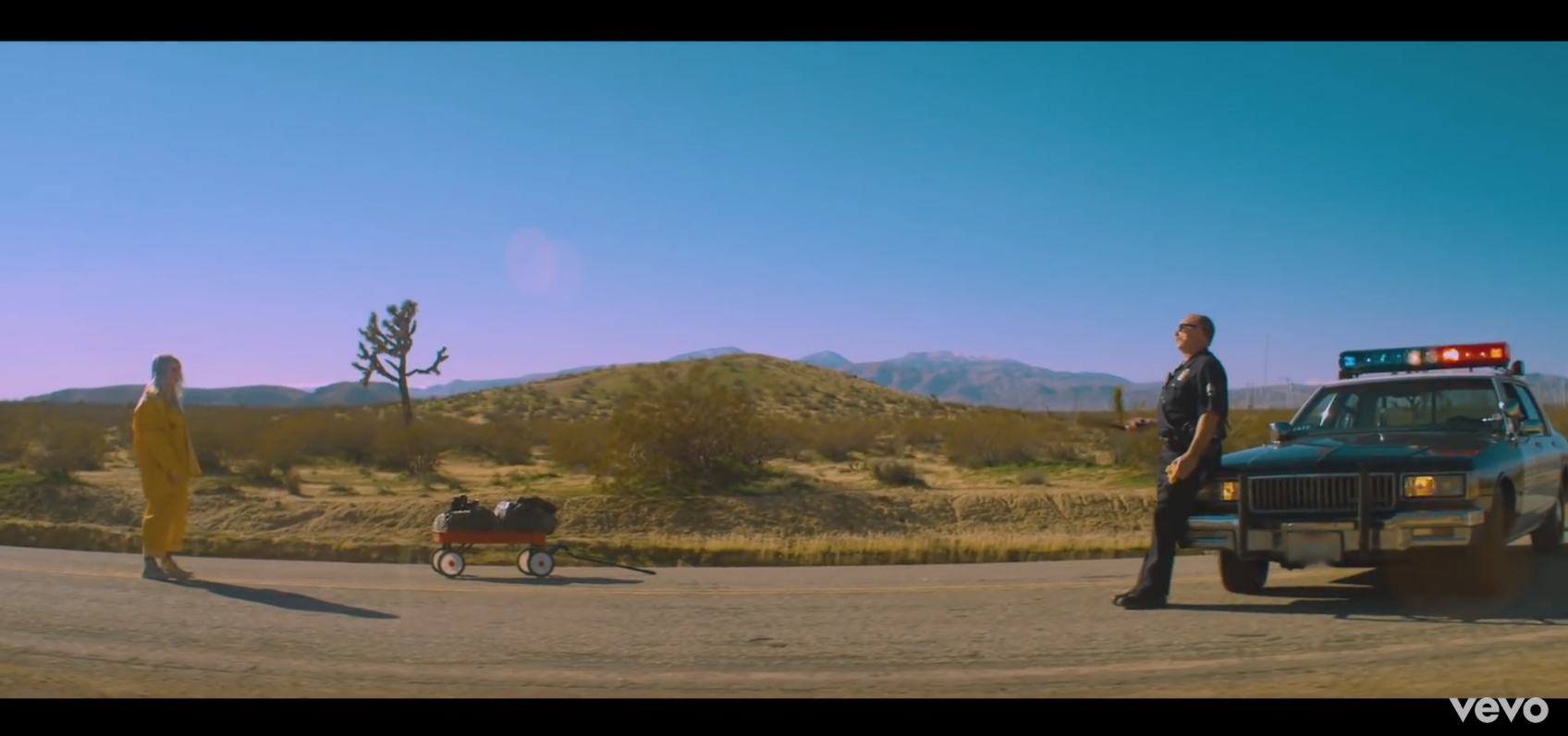
In this music video, the opening shot is a wide frame shot of the singer stranded in the middle of the highway. Her eye-catching yellow outfit as well as her icy grey hair, and red wagon in hand, are all elements that contrast against the very natural and deserted background. The story-line of this video unlike her previous two, showcase narrative-like aspects. Basically, Billie is stranded in the middle of the highway whilst carry a red wagon filled with trash bags loaded with cash which appears to be stolen. Billie Lip dubs and “preforms” the entire song on this road that leads to nowhere, till a cop car comes into the frame and Billie and the cop stand opposite each other in silence as the MV fades into darkness.  

             Each scene was focused on cuts that would zoom into Billie’s minimal movement and sort of dancing and vibing to the song, playing with the stolen cash, and while also zooming out showing the vast space and natural area surrounding her. The camera work allowed us to feel the sense of recklessness that Billie was facing as she danced in the middle of the highway carelessly to the beats of her music. The movements appear to be unchoreographed or rehearsed and you can truly feel the rawness and how she truly feels with the music. The primary colors stood out amongst the raw saturated background, but also highlighted Billie’s unapologetic actions and evoked even more fearlessness in her motions. 

            Evidently, there is something haunting about being isolated in the middle of a highway, crossing around and dancing in the middle where perhaps at any moment a car could come speeding by. I think the juxtaposing of the bright primary and overly saturated colors acted sort of like a thematic oxymoron. Maybe it was to conceal the spooky undertone, but I feel as though if anything it highlights it.

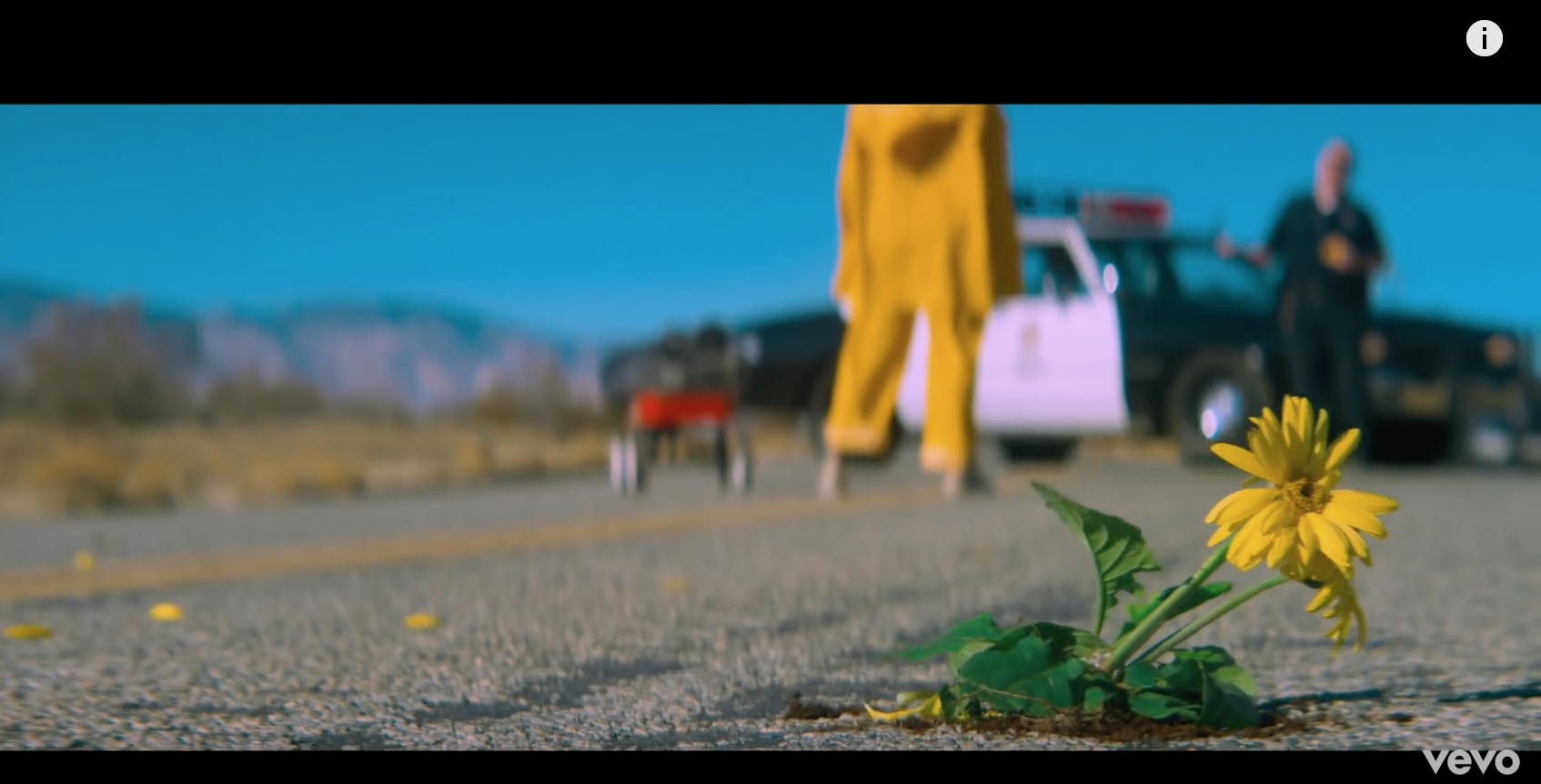
The last 30 seconds of the music video, starting at 3.00 have to be my favorite. I think the way it was because it was very detail-oriented and created a very movie-like feel. It reminded me of a Western movie standoff. As the music dies down and the sound of the cop car sirens become more prominent, Billie is facing a police officer who has parked his car in the middle of the highway that she was prancing around seconds ago. She now is almost isolated, and lets go of her wagon of cash that slowly begins to role up the road towards the cop. The cop is scene swinging his black stick in one-hand while eating his donut, and Billie is seen with a very intense look in her eyes as the wind blows her hair onto her face. The camera zooms out into in undershot camera angled away from the two subjects, but towards Billie’s side, and focuses on a yelow sunflower placed in the middle of the concrete highway that slowly falls and dies down into the ground.

The next clip cuts into an overhead shot of the scene, but towards the cop’s side, that gives us an illusion of the closenes between the two subjects.

The next shot is a close-up shot of Billie that cuts into another close-up shot of the cop.

The final shot is a zoomed out over-view shot of both of them stil very distanced, with nothing but nature and the wagon filled with cash between them.

Six Feet Under (2016)

Billie Eilish’s second music video is for her song “Six Feet Under” (2016). This is specifically a special music video as it is the first one that she personally directs. Although not apparent at all in the music video, interestingly, the music video is of color smoke bombs erupting. A very different take compared to her first one, this music video allowed me to view her music videos from a more artistic perspective. Rather than explicitly re-enacting her lyrics, or preforming the song, Billie Eilish decided to capture emotion through this object.

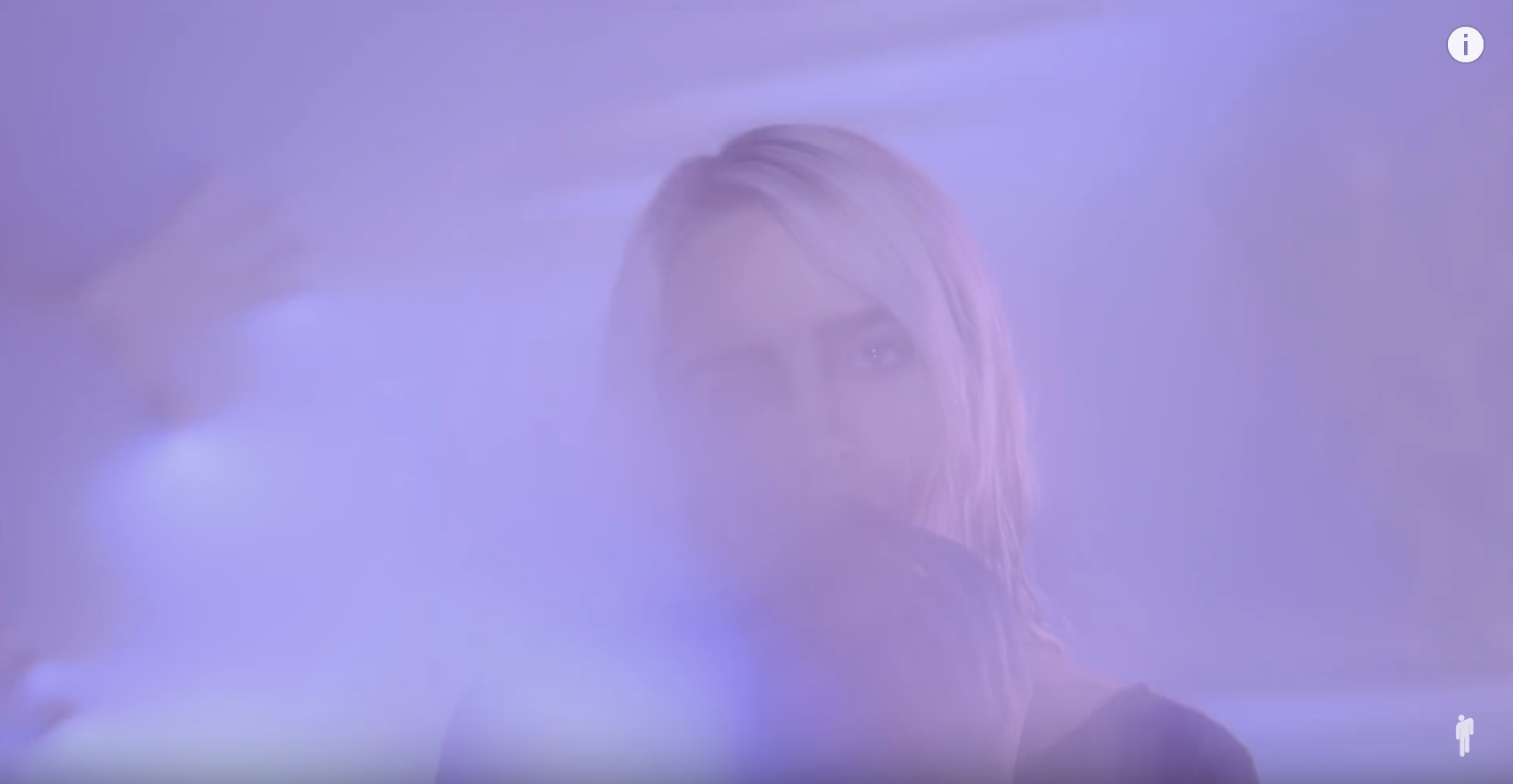
The entirety of the video consists of these explosions of smoke and color that appear to be filmed on someone’s backyard. There is a rawness and home-made video feel to it, kind of rustic. 

            The opening clip is of two already erupted smoke bombs, blue and red, the smoke erupts for approximately 8 seconds and then the clip is reversed to create an effect as though the smoke is moving backwards. The next clip beginning at 0.15 is of someone lighting a smoke bomb and the entire process is shown from when its lit to when it erupts. From 0.15 to 1.56, the smoke bomb erupts and reveals a cloud of yellow colored smoke. From1.57 onwards, the clip is reversed and sped up again, allow the eruption of smoke to cave back into the small capsule it came out of. At 2.17, a clip of the smoke bomb dying off is inserted as the yellow smoke evaporates from the frame. At 2.30 a clip of the blue and red smoke erupting till the bombs die off and the smoke exits the frame, then the video cuts back to the yellow smoke bomb showing barely any remnants of the smoke. 

            Visually, it was very interesting to see the juxtaposition of the primary colors of smoke onto the dark colored wood and cobwebs. The fluidity versus the harshness. The play with timing and rewinding, specifically with the movement of smoke and action of eruption and suppression was also simple yet visually very rich.

Ocean Eyes (2016)

Ocean Eyes(2016)

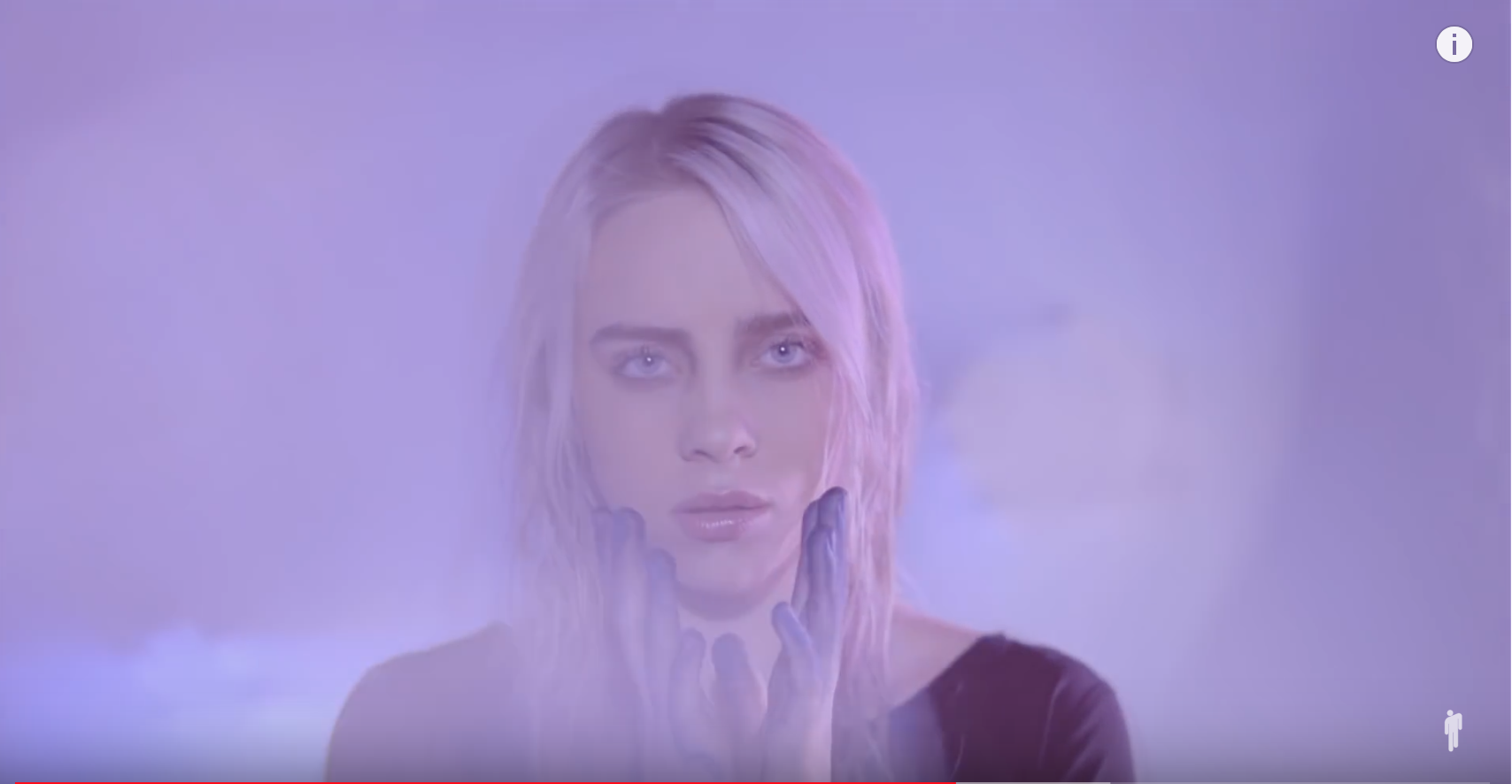
Beginning with Bilie Eilish’s first music video, “Ocean Eyes” (2016), we can truly see how her career catapulted after that. A young Billie, approximately 14, lip dubs the entire song in this performative music video. Positioned in the center of the frame, whilst singing her song, there is almost an icy-tone to the visual aesthetics of the music video. 

Her cool-toned grey hair meshing into the backdrop highlights the play on light that is carried throughout the music video.  As the music video performance goes on, the foreground begins to move. What appeared to be a backlit semi-translucent fabric-like backdrop appears to be multifaceted as the silhouette of hands and finger-tips imprint and create movement. 

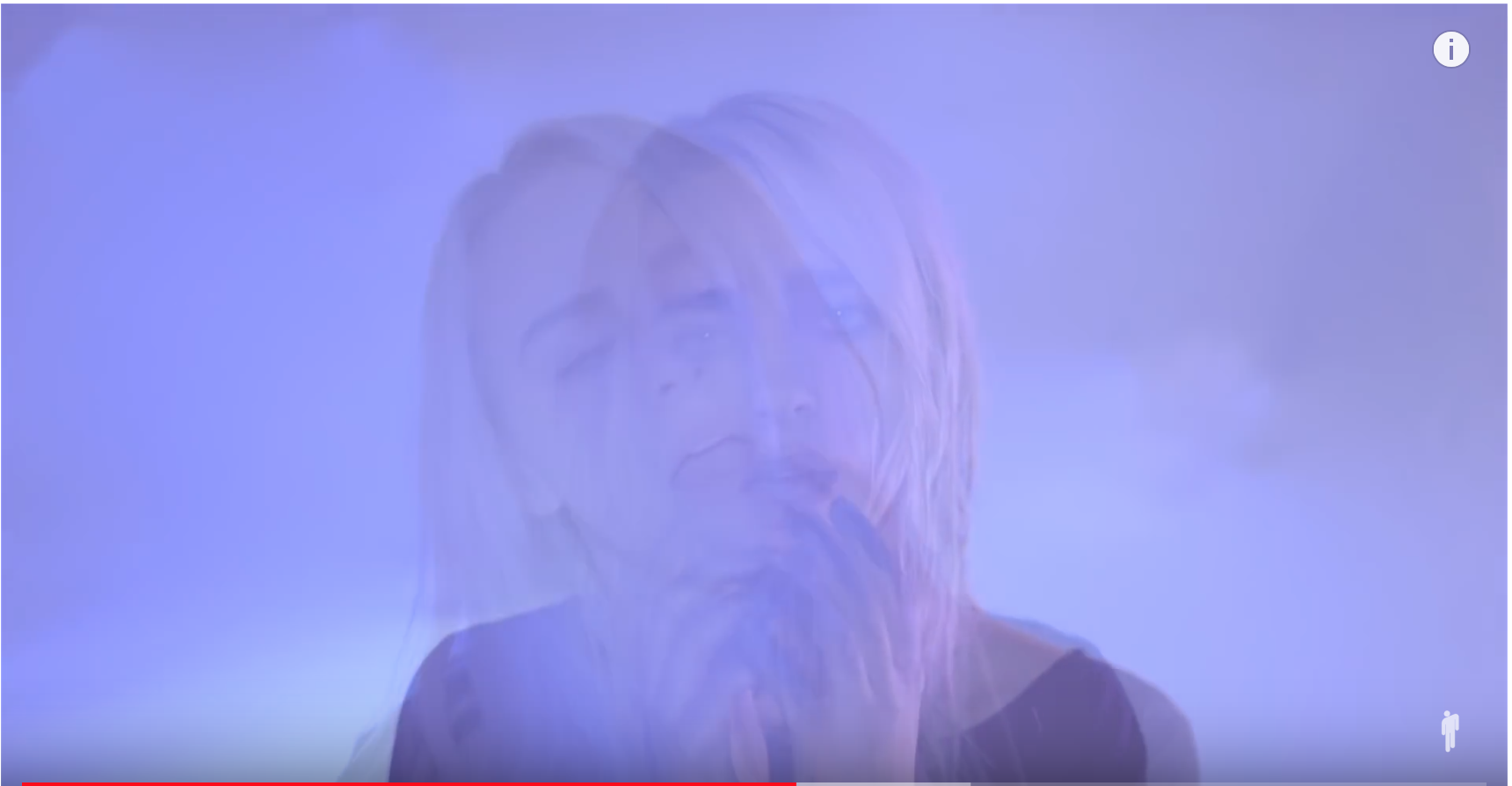
The theme of hands, recurs as Billie’s hands come into the frame and appear to be stained by a dark substance. Billie begins to make uncomfortable gestures with her hand as she continues to sing the song, this movement highlights the beats and pace of the music as she matches the musical score. The movements appear to be unrehearsed and almost flow so naturally with Billie’s singing that it creates a very pleasing visual motion. As the song splits into two harmonies, an additional layer of the same frame is added onto the original one and the editors appear to have experimented with the opacity and overlaying of the clips beginning at (1.44). This split of frame shifts our attention to the focus on movement in this MV. The movement of the foreground as well as the first layer and then the second layer all mesh together to create a very delicate and fluid-like aesthetic.

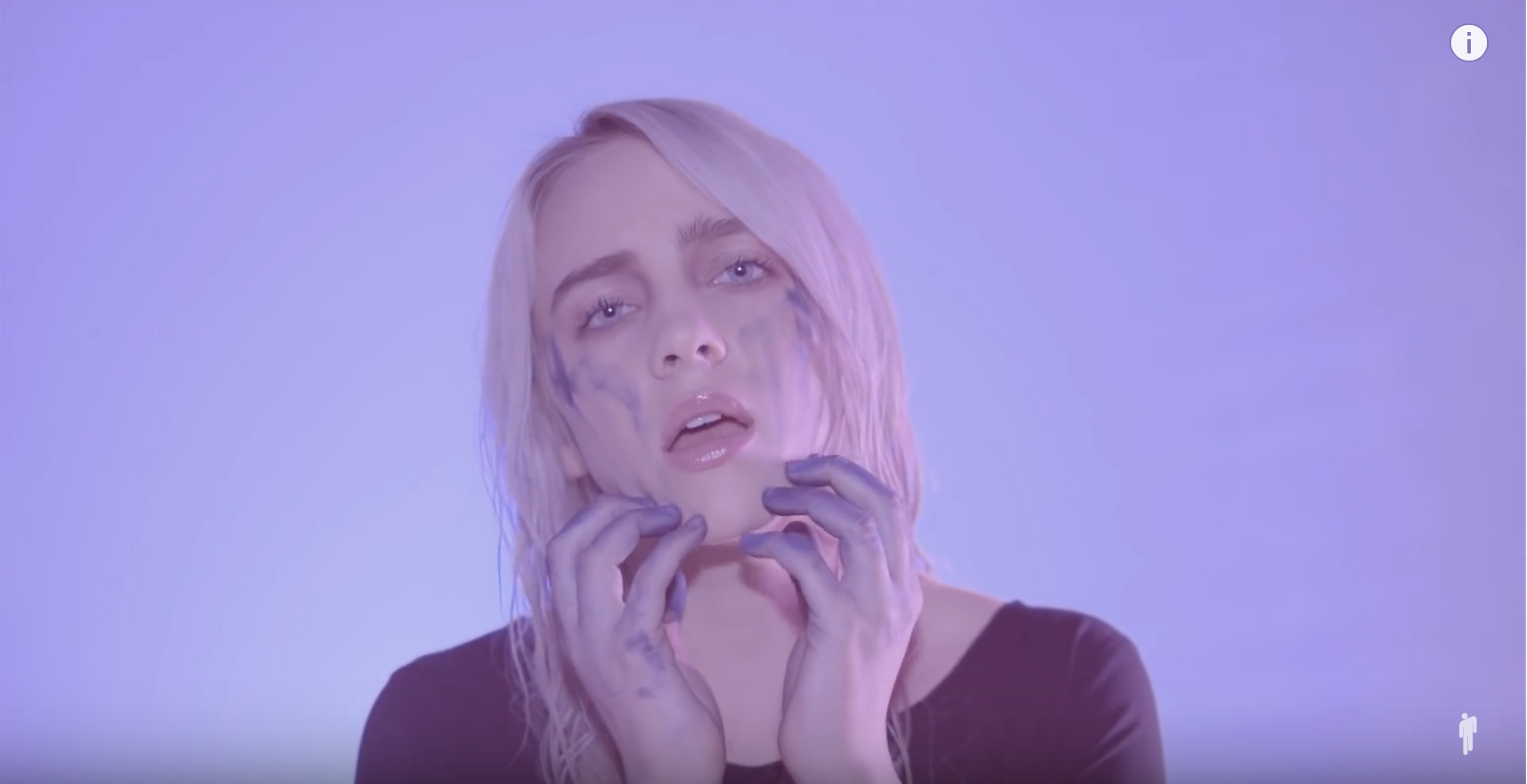
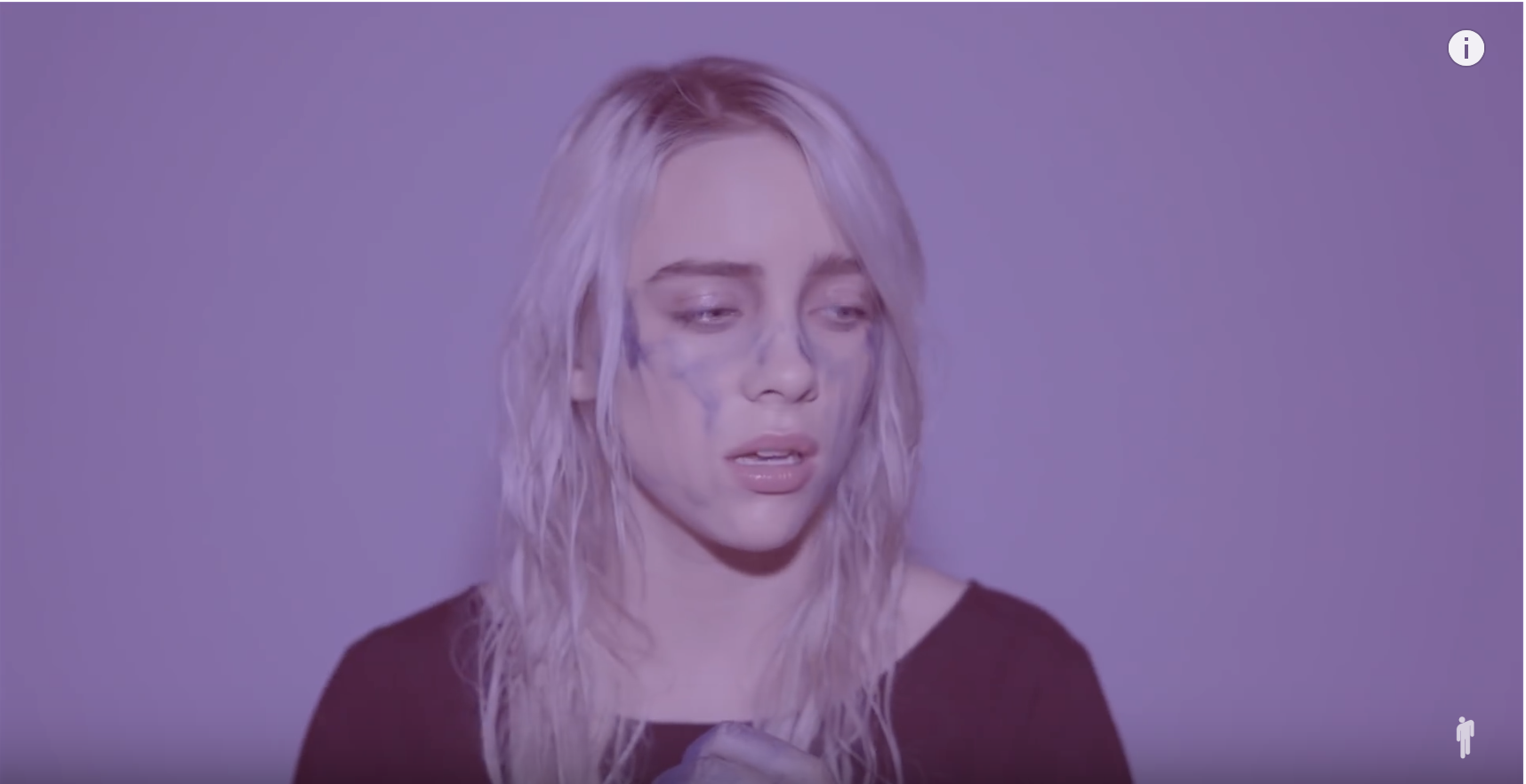
At (2.40), Billie begins to place her stained fingers onto the sides of her cheeks and allows for substance on her fingers to stain her cheeks. She smudges the streaks downwards onto in a kind of caressing-like motion.  She softly moves her fingers up and down slowly, matching the pace in the music, as it has now slowed down nearing the end. The one-take like clip begins to fade into darkness and the last image prior to a black screen is Billies face stained with the dark streaks.


Design a site like this with WordPress.com
Get started